1
/
of
1
Human IRAK-4 (Interleukin-1 Receptor-associated Kinase 4) ELISA Kit
Human IRAK-4 (Interleukin-1 Receptor-associated Kinase 4) ELISA Kit
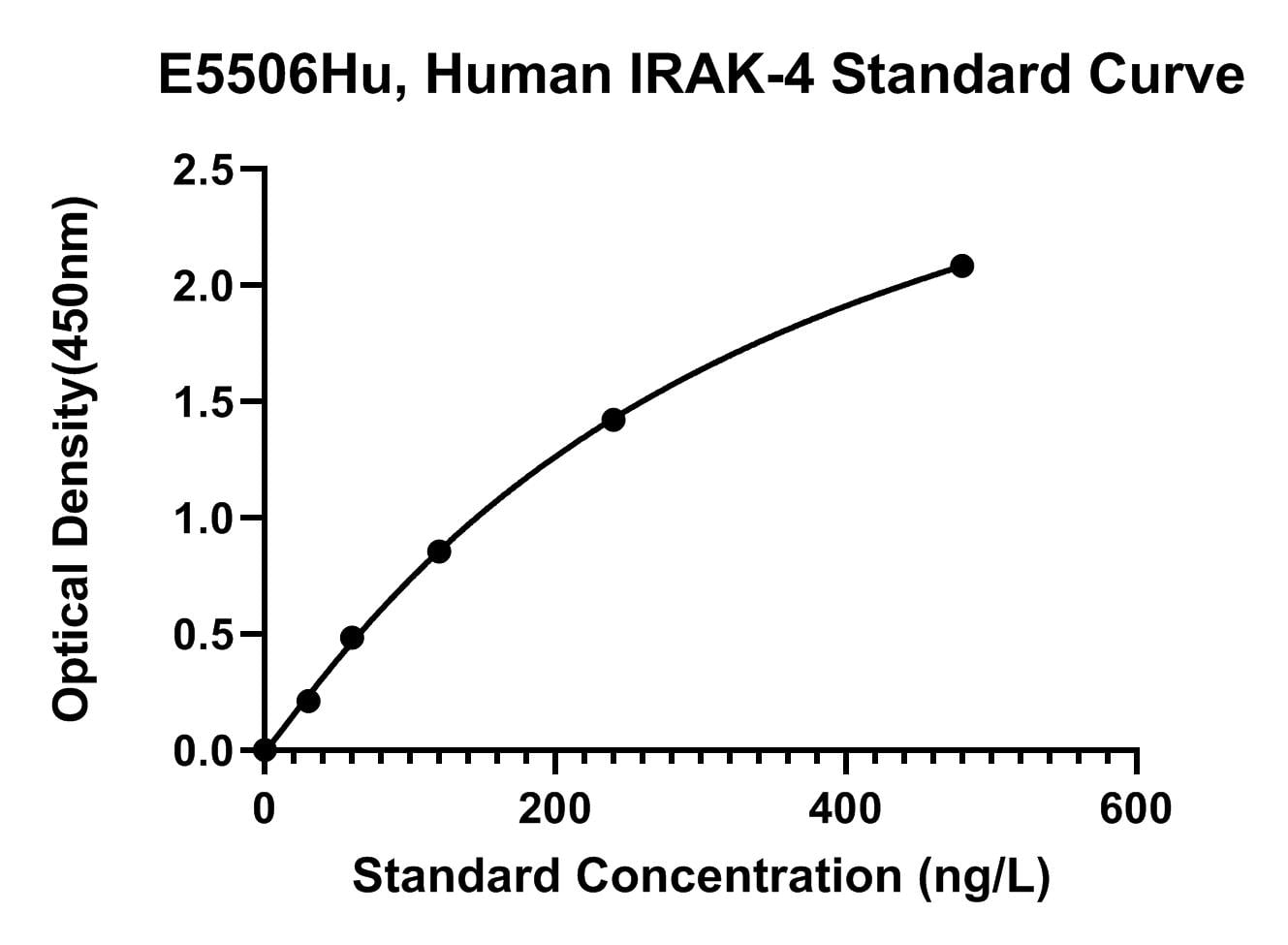
The Human (IRAK-4) Interleukin-1 Receptor-associated Kinase 4 ELISA Kit measures Interleukin-1 Receptor-Associated Kinase 4 in samples. The plate has been pre-coated with Human IRAK4 antibody. IRAK4 present in the sample is added and binds to antibodies coated on the wells. And then biotinylated Human IRAK4 Antibody is added and binds to IRAK4 in the sample. Then Streptavidin-HRP is added and binds to the Biotinylated IRAK4 antibody. After incubation unbound Streptavidin-HRP is washed away during a washing step. Substrate solution is then added and color develops in proportion to the amount of Human IRAK4. The reaction is terminated by addition of acidic stop solution and absorbance is measured at 450 nm.
Catalog No:
E5506Hu
Regular price
$595.00 USD
Regular price
$458.00 USD
Sale price
$595.00 USD
Unit price
/
per
2.5 weeks
Couldn't load pickup availability
Product Details
Species Reactivity
Human
Sensitivity
1.31 ng/L
Detection Range
3-900 ng/L
Sample Type
Serum, plasma, cell culture supernates
Incubation(s)
1.5 hour(s)
Research Areas
Immunology, Cytokines, Enzyme & Kinase, Inflammation
Background
Serine/threonine-protein kinase that plays a critical role in initiating innate immune response against foreign pathogens. Involved in Toll-like receptor (TLR) and IL-1R signaling pathways (PubMed: 17878374). Is rapidly recruited by MYD88 to the receptor-signaling complex upon TLR activation to form the Myddosome together with IRAK2. Phosphorylates initially IRAK1, thus stimulating the kinase activity and intensive autophosphorylation of IRAK1. Phosphorylates E3 ubiquitin ligases Pellino proteins (PELI1, PELI2 and PELI3) to promote pellino-mediated polyubiquitination of IRAK1. Then, the ubiquitin-binding domain of IKBKG/NEMO binds to polyubiquitinated IRAK1 bringing together the IRAK1-MAP3K7/TAK1-TRAF6 complex and the NEMO-IKKA-IKKB complex. In turn, MAP3K7/TAK1 activates IKKs (CHUK/IKKA and IKBKB/IKKB) leading to NF-kappa-B nuclear translocation and activation. Alternatively, phosphorylates TIRAP to promote its ubiquitination and subsequent degradation. Phosphorylates NCF1 and regulates NADPH oxidase activation after LPS stimulation suggesting a similar mechanism during microbial infections. Source: UniProt Consortium (2025)
Shipping Condition
Shipped on cold gel packs.
Storage Condition and Shelf Life
2-8C
Analyte
Interleukin-1 Receptor-Associated Kinase 4
Regulatory Status
For Research Use Only