1
/
of
1
Human KCNK1 (Potassium Channel Subfamily K Member 1) ELISA Kit
Human KCNK1 (Potassium Channel Subfamily K Member 1) ELISA Kit
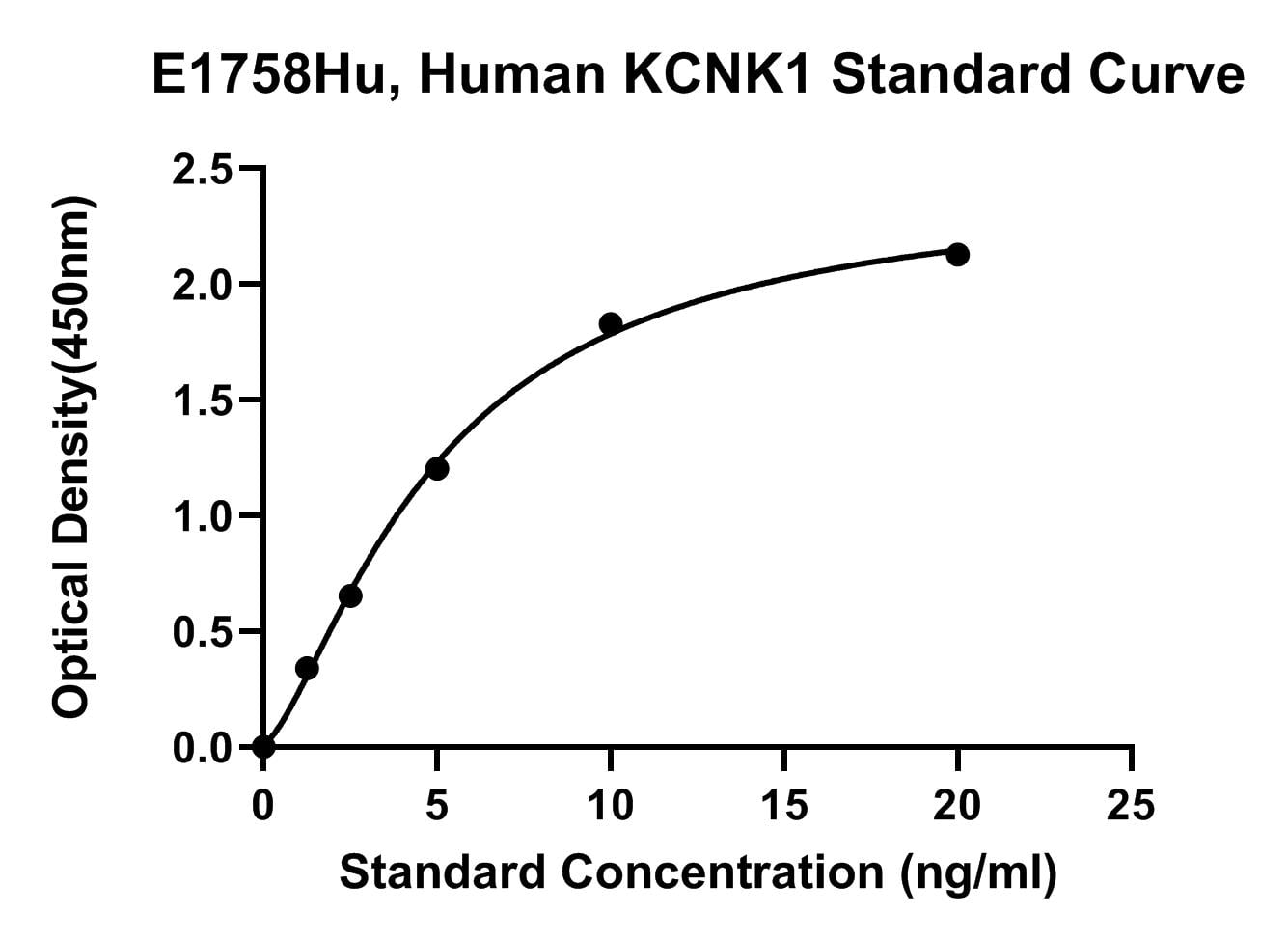
The Human (KCNK1) Potassium Channel Subfamily K Member 1 ELISA Kit measures Potassium Channel Subfamily K Member 1 in samples. The plate has been pre-coated with Human KCNK1 antibody. KCNK1 present in the sample is added and binds to antibodies coated on the wells. And then biotinylated Human KCNK1 Antibody is added and binds to KCNK1 in the sample. Then Streptavidin-HRP is added and binds to the Biotinylated KCNK1 antibody. After incubation unbound Streptavidin-HRP is washed away during a washing step. Substrate solution is then added and color develops in proportion to the amount of Human KCNK1. The reaction is terminated by addition of acidic stop solution and absorbance is measured at 450 nm.
Catalog No:
E1758Hu
Regular price
$595.00 USD
Regular price
$458.00 USD
Sale price
$595.00 USD
Unit price
/
per
2.5 weeks
Couldn't load pickup availability
Product Details
Species Reactivity
Human
Sensitivity
0.045 ng/mL
Detection Range
0.1-35 ng/mL
Sample Type
Serum, plasma, cell culture supernates
Incubation(s)
1.5 hour(s)
Research Areas
Neuroscience
Background
Ion Channel that contributes to passive transmembrane potassium transport and to the regulation of the resting membrane potential in brain astrocytes, but also in kidney and in other tissues (PubMed: 15820677, PubMed: 21653227). Forms dimeric Channels through which potassium ions pass in accordance with their electrochemical gradient. The Channel is selective for K(+) ions at physiological potassium concentrations and at neutral pH, but becomes permeable to Na(+) at subphysiological K(+) levels and upon acidification of the extracellular medium (PubMed: 21653227, PubMed: 22431633). The homodimer has very low potassium Channel activity, when expressed in heterologous systems, and can function as weakly inward rectifying potassium Channel (PubMed: 8605869, PubMed: 8978667, PubMed: 15820677, PubMed: 21653227, PubMed: 22431633, PubMed: 23169818, PubMed: 25001086). Channel activity is modulated by activation of serotonin receptors (By similarity). Heterodimeric Channels containing KCNK1 and KCNK2 have much higher activity, and may represent the predominant form in astrocytes (By similarity). Heterodimeric Channels containing KCNK1 and KCNK3 or KCNK9 have much higher activity (PubMed: 23169818). Heterodimeric Channels formed by KCNK1 and KCNK9 may contribute to halothane-sensitive currents (PubMed: 23169818). Mediates outward rectifying potassium currents in dentate gyrus granule cells and contributes to the regulation of their resting membrane potential (By similarity). Contributes to the regulation of action potential firing in dentate gyrus granule cells and down-regulates their intrinsic excitability (By similarity). In astrocytes, the heterodimer formed by KCNK1 and KCNK2 is required for rapid glutamate release in response to activation of G-protein coupled receptors, such as F2R and CNR1 (By similarity). Required for normal ion and water transport in the kidney (By similarity). Contributes to the regulation of the resting membrane potential of pancreatic beta cells (By similarity). The low Channel activity of homodimeric KCNK1 may be due to sumoylation (PubMed: 15820677, PubMed: 20$498.00|$360.00050, PubMed: 23169818). The low Channel activity may be due to rapid internalization from the cell membrane and retention in recycling endosomes (PubMed: 19959478). Source: UniProt Consortium (2025)
Shipping Condition
Shipped on cold gel packs.
Storage Condition and Shelf Life
2-8C
Analyte
Potassium Channel Subfamily K Member 1
Regulatory Status
For Research Use Only