1
/
of
1
Human KCNK9 (Potassium Channel Subfamily K Member 9) ELISA Kit
Human KCNK9 (Potassium Channel Subfamily K Member 9) ELISA Kit
The Human (KCNK9) Potassium Channel Subfamily K Member 9 ELISA Kit measures Potassium Channel subfamily K member 9 in samples. The plate has been pre-coated with Human KCNK9 antibody. KCNK9 present in the sample is added and binds to antibodies coated on the wells. And then biotinylated Human KCNK9 Antibody is added and binds to KCNK9 in the sample. Then Streptavidin-HRP is added and binds to the Biotinylated KCNK9 antibody. After incubation unbound Streptavidin-HRP is washed away during a washing step. Substrate solution is then added and color develops in proportion to the amount of Human KCNK9. The reaction is terminated by addition of acidic stop solution and absorbance is measured at 450 nm.
Catalog No:
E1765Hu
Regular price
$595.00 USD
Regular price
$458.00 USD
Sale price
$595.00 USD
Unit price
/
per
2.5 weeks
Couldn't load pickup availability
Product Details
Species Reactivity
Human
Sensitivity
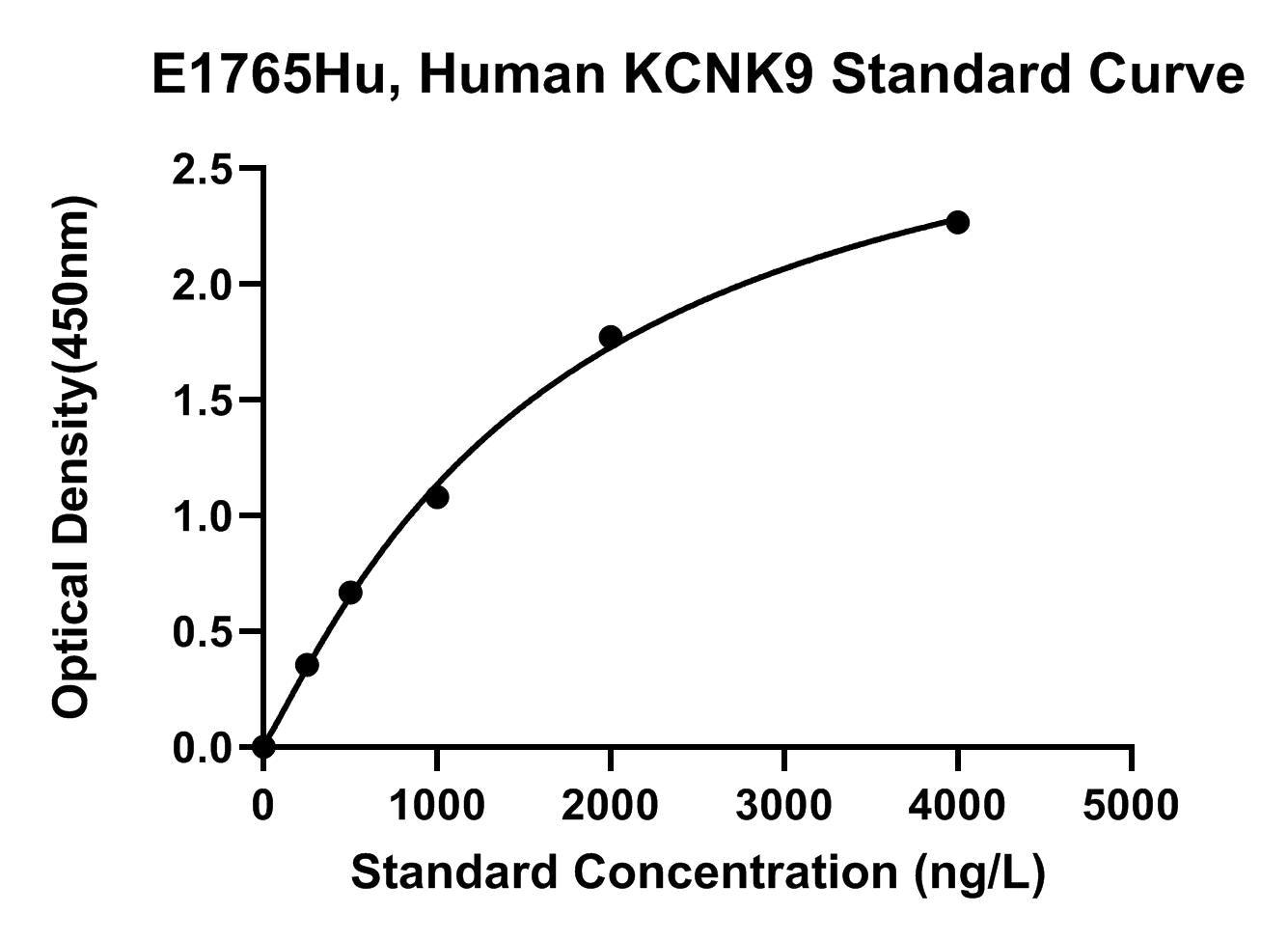
9.92 ng/L
Detection Range
20-7000 ng/L
Sample Type
Serum, plasma, cell culture supernates
Incubation(s)
1.5 hour(s)
Research Areas
Neuroscience
Background
Potassium channel subfamily K member 9 is a protein that in humans is encoded by the KCNK9 gene. This gene encodes K2P9.1, one of the members of the superfamily of potassium channel proteins containing two pore-forming P domains. This open channel is highly expressed in the cerebellum. It is inhibited by extracellular acidification and arachidonic acid, and strongly inhibited by phorbol 12-myristate 13-acetate. Phorbol 12-myristate 13-acetate is also known as 12-O-tetradecanoylphorbol-13-acetate (TPA). TASK channels are additionally inhibited by hormones and transmitters that signal through GqPCRs. The resulting cellular depolarization is thought to regulate processes such as motor control and aldosterone secretion. Despite early controversy about the exact mechanism underlying this inhibition, the current view is that Diacyl-glycerol, produced by the breakdown of Phosphatidylinositol-4,5-bis-phosphate by Phospholipase CBeta causes channel closure. Source: UniProt Consortium (2025)
Shipping Condition
Shipped on cold gel packs.
Storage Condition and Shelf Life
2-8C
Analyte
Potassium Channel subfamily K member 9
Regulatory Status
For Research Use Only