1
/
of
1
Human NLRC3 (Nlr Family, Card Domain Containing 3) ELISA Kit
Human NLRC3 (Nlr Family, Card Domain Containing 3) ELISA Kit
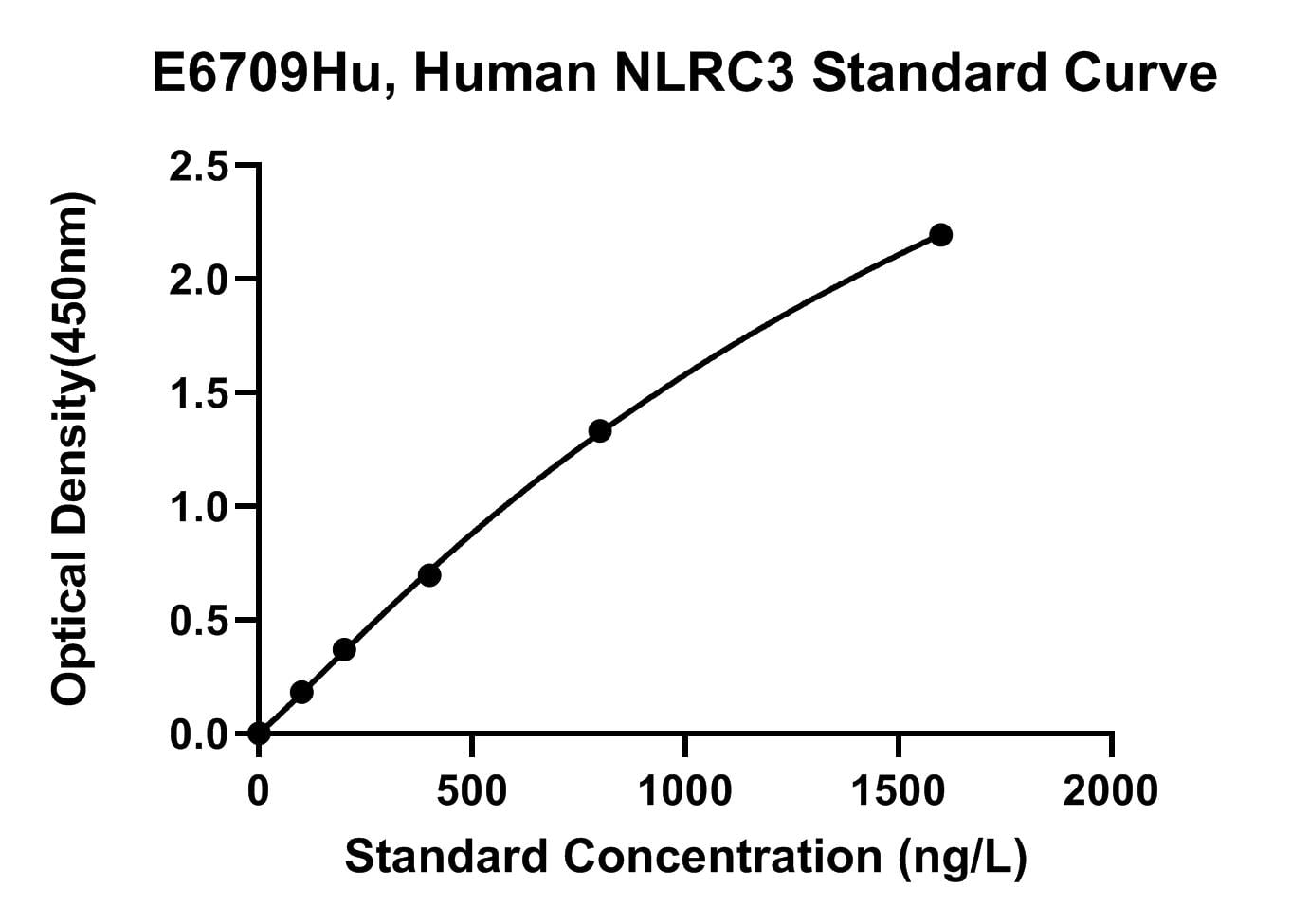
The Human (NLRC3) Nlr Family, Card Domain Containing 3 ELISA Kit measures Nlr Family, Card Domain Containing 3 in samples. The plate has been pre-coated with Human NLRC3 antibody. NLRC3 present in the sample is added and binds to antibodies coated on the wells. And then biotinylated Human NLRC3 Antibody is added and binds to NLRC3 in the sample. Then Streptavidin-HRP is added and binds to the Biotinylated NLRC3 antibody. After incubation unbound Streptavidin-HRP is washed away during a washing step. Substrate solution is then added and color develops in proportion to the amount of Human NLRC3. The reaction is terminated by addition of acidic stop solution and absorbance is measured at 450 nm.
Catalog No:
E6709Hu
Regular price
$595.00 USD
Regular price
$458.00 USD
Sale price
$595.00 USD
Unit price
/
per
2.5 weeks
Couldn't load pickup availability
Product Details
Species Reactivity
Human
Sensitivity
7.84 ng/L
Detection Range
15-3000 ng/L
Sample Type
Serum, plasma, cell culture supernates
Incubation(s)
1.5 hour(s)
Research Areas
Immunology
Background
Negative regulator of the innate immune response (PubMed: 15705585, PubMed: 22863753, PubMed: 25277106). Attenuates signaling pathways activated by Toll-like receptors (TLRs) and the DNA sensor STING/TMEM173 in response to pathogen-associated molecular patterns, such as intracellular poly(dA:dT), but not poly(I:C), or in response to DNA virus infection, including that of Herpes simplex virus 1 (HSV1) (By similarity) (PubMed: 22863753). May affect TLR4 signaling by acting at the level of TRAF6 ubiquitination, decreasing the activating 'Lys-63'-linked ubiquitination and leaving unchanged the degradative 'Lys-48'-linked ubiquitination (PubMed: 22863753). Inhibits the PI3K-AKT-mTOR pathway possibly by directly interacting with the posphatidylinositol 3-kinase regulatory subunit p85 (PIK3R1/PIK3R2) and disrupting the association between PIK3R1/PIK3R2 and the catalytic subunit p110 (PIK3CA/PIK3CB/PIK3CD) and reducing PIK3R1/PIK3R2 activation. Via its regulation of the PI3K-AKT-mTOR pathway, controls cell proliferation, predominantly in intestinal epithelial cells (By similarity). May also affect NOD1- or NOD2-mediated NF-kappa-B activation (PubMed: 25277106). Might also affect the inflammatory response by preventing NLRP3 inflammasome formation, CASP1 cleavage and IL1B maturation (PubMed: 25277106). Source: UniProt Consortium (2025)
Shipping Condition
Shipped on cold gel packs.
Storage Condition and Shelf Life
2-8C
Analyte
Nlr Family, Card Domain Containing 3
Regulatory Status
For Research Use Only