1
/
of
1
Human PLA2G2A (Phospholipase A2) ELISA Kit
Human PLA2G2A (Phospholipase A2) ELISA Kit
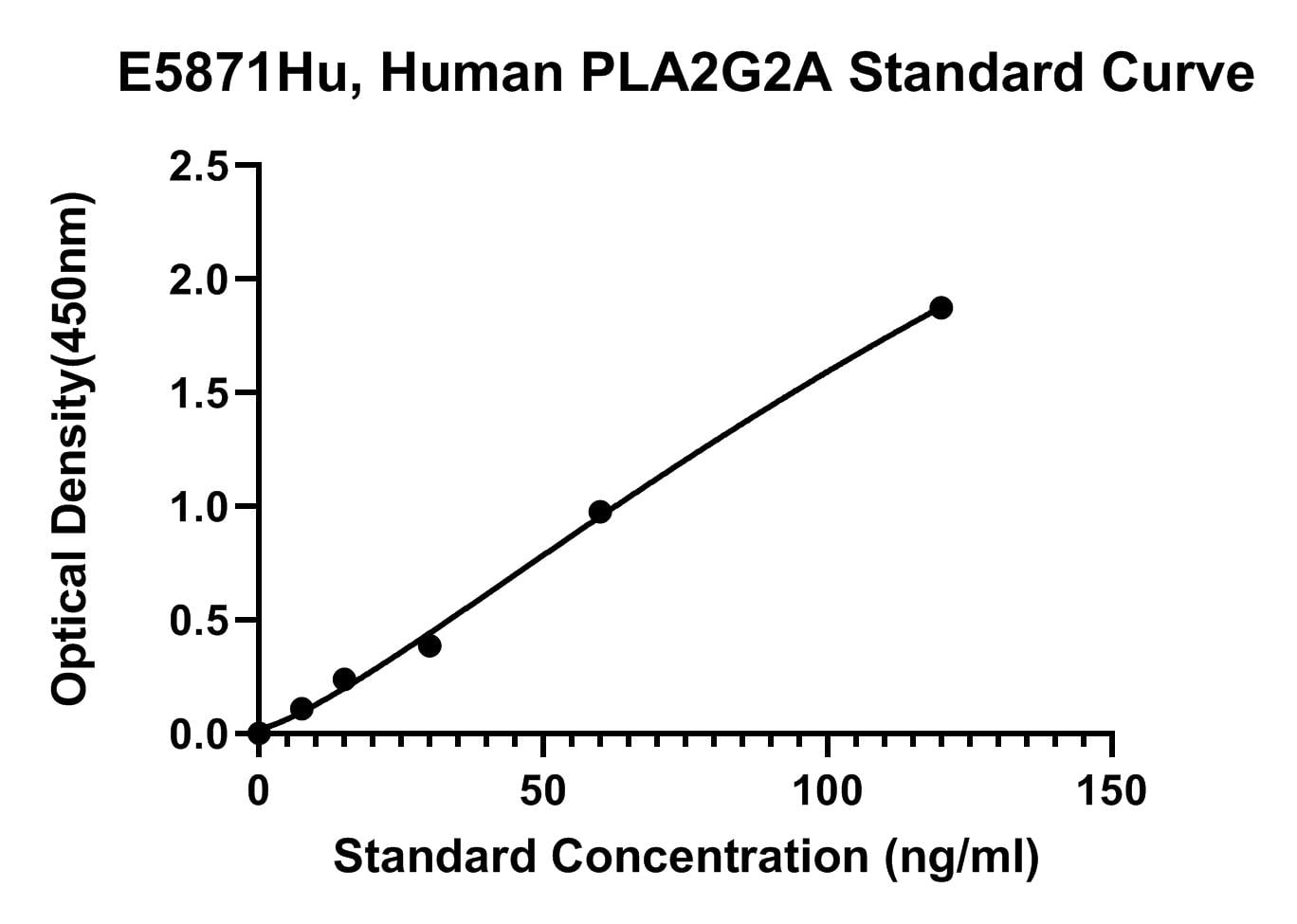
The Human (PLA2G2A) Phospholipase A2 ELISA Kit measures Phospholipase A2 in samples. The plate has been pre-coated with Human PLA2G2A antibody. PLA2G2A present in the sample is added and binds to antibodies coated on the wells. And then biotinylated Human PLA2G2A Antibody is added and binds to PLA2G2A in the sample. Then Streptavidin-HRP is added and binds to the Biotinylated PLA2G2A antibody. After incubation unbound Streptavidin-HRP is washed away during a washing step. Substrate solution is then added and color develops in proportion to the amount of Human PLA2G2A. The reaction is terminated by addition of acidic stop solution and absorbance is measured at 450 nm.
Catalog No:
E5871Hu
Regular price
$595.00 USD
Regular price
$458.00 USD
Sale price
$595.00 USD
Unit price
/
per
2.5 weeks
Couldn't load pickup availability
Product Details
Species Reactivity
Human
Sensitivity
0.32 ng/mL
Detection Range
0.5-200 ng/mL
Sample Type
Serum, plasma, cell culture supernates
Incubation(s)
1.5 hour(s)
Research Areas
Cardiovascular, Signal Transduction, Metabolism
Background
Secretory calcium-dependent phospholipase A2 that primarily targets extracellular phospholipids with implications in host antimicrobial defense, inflammatory response and tissue regeneration (PubMed:10455175, PubMed:10681567, PubMed:2925633).
Hydrolyzes the ester bond of the fatty acyl group attached at sn-2 position of phospholipids (phospholipase A2 activity) with preference for phosphatidylethanolamines and phosphatidylglycerols over phosphatidylcholines (PubMed:10455175, PubMed:10681567).
Contributes to lipid remodeling of cellular membranes and generation of lipid mediators involved in pathogen clearance. Displays bactericidal activity against Gram-positive bacteria by directly hydrolyzing phospholipids of the bacterial membrane (PubMed:11694541, PubMed:10358193).
Upon sterile inflammation, targets membrane phospholipids of extracellular mitochondria released from activated platelets, generating free unsaturated fatty acids such as arachidonate that is used by neighboring leukocytes to synthesize inflammatory eicosanoids such as leukotrienes. Simultaneously, by compromising mitochondrial membrane integrity, promotes the release in circulation of potent damage-associated molecular pattern molecules that activate the innate immune response (PubMed:25082876).
Plays a stem cell regulator role in the intestinal crypt. Within intracellular compartment mediates Paneth cell differentiation and its stem cell supporting functions by inhibiting Wnt signaling pathway in intestinal stem cell (ICS). Secreted in the intestinal lumen upon inflammation, acts in an autocrine way and promotes prostaglandin E2 synthesis that stimulates Wnt signaling pathway in ICS cells and tissue regeneration (By similarity).
May play a role in the biosynthesis of N-acyl ethanolamines that regulate energy metabolism and inflammation. Hydrolyzes N-acyl phosphatidylethanolamines to N-acyl lysophosphatidylethanolamines, which are further cleaved by a lysophospholipase D to release N-acyl ethanolamines (PubMed:14998370).
Independent of its catalytic activity, acts as a ligand for integrins (PubMed:18635536, PubMed:25398877).
Binds to and activates integrins ITGAV:ITGB3, ITGA4:ITGB1 and ITGA5:ITGB1 (PubMed:18635536, PubMed:25398877).
Binds to a site (site 2) which is distinct from the classical ligand-binding site (site 1) and induces integrin conformational changes and enhanced ligand binding to site 1 (PubMed:25398877).
Induces cell proliferation in an integrin-dependent manner (PubMed:18635536). Source: UniProt Consortium (2025)
Shipping Condition
Shipped on cold gel packs.
Storage Condition and Shelf Life
2-8C
Analyte
Phospholipase A2
Regulatory Status
For Research Use Only