1
/
of
1
Human PUM1 (Pumilio Homolog 1) ELISA Kit
Human PUM1 (Pumilio Homolog 1) ELISA Kit
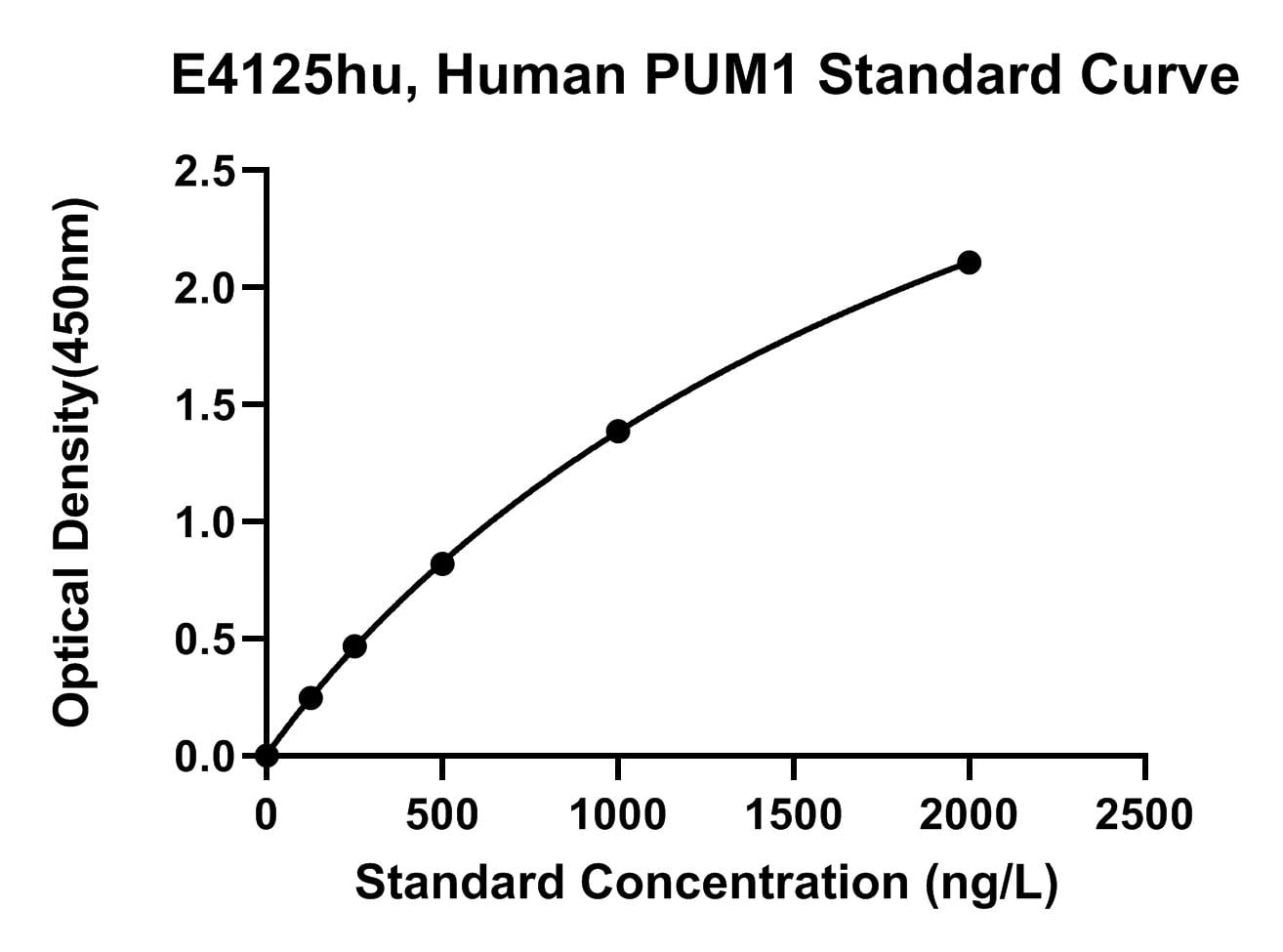
The Human (PUM1) Pumilio Homolog 1 ELISA Kit measures Pumilio Homolog 1 in samples. The plate has been pre-coated with Human PUM1 antibody. PUM1 present in the sample is added and binds to antibodies coated on the wells. And then biotinylated Human PUM1 Antibody is added and binds to PUM1 in the sample. Then Streptavidin-HRP is added and binds to the Biotinylated PUM1 antibody. After incubation unbound Streptavidin-HRP is washed away during a washing step. Substrate solution is then added and color develops in proportion to the amount of Human PUM1. The reaction is terminated by addition of acidic stop solution and absorbance is measured at 450 nm.
Catalog No:
E4125hu
Regular price
$595.00 USD
Regular price
$458.00 USD
Sale price
$595.00 USD
Unit price
/
per
2.5 weeks
Couldn't load pickup availability
Product Details
Species Reactivity
Human
Sensitivity
7.82 ng/L
Detection Range
15-3500 ng/L
Sample Type
Serum, plasma, cell culture supernates
Incubation(s)
1.5 hour(s)
Research Areas
Epigenetics and Nuclear Signaling
Background
Sequence-specific RNA-binding protein that acts as a post-transcriptional repressor by binding the 3'-UTR of mRNA targets. Binds to an RNA consensus sequence, the Pumilio Response Element (PRE), 5'-UGUANAUA-3', that is related to the Nanos Response Element (NRE) (PubMed: 21572425, PubMed: 18328718, PubMed: 21653694, PubMed: 21397187). Mediates post-transcriptional repression of transcripts via different mechanisms: acts via direct recruitment of the CCR4-POP2-NOT deadenylase leading to translational inhibition and mRNA degradation (PubMed: 22955276). Also mediates deadenylation-independent repression by promoting accessibility of miRNAs (PubMed: 18776931, PubMed: 20818387, PubMed: 20860814, PubMed: 22345517). Following growth factor stimulation, phosphorylated and binds to the 3'-UTR of CDKN1B/p27 mRNA, inducing a local conformational change that exposes miRNA-binding sites, promoting association of miR-221 and miR-222, efficient suppression of CDKN1B/p27 expression, and rapid entry to the cell cycle (PubMed: 20818387). Acts as a post-transcriptional repressor of E2F3 mRNAs by binding to its 3'-UTR and facilitating miRNA regulation (PubMed: 22345517, PubMed: 29474920). Represses a program of genes necessary to maintain genomic stability such as key mitotic, DNA repair and DNA replication factors. Its ability to repress those target mRNAs is regulated by the lncRNA NORAD (non-coding RNA activated by DNA damage) which, due to its high abundance and multitude of PUMILIO binding sites, is able to sequester a significant fraction of PUM1 and PUM2 in the cytoplasm (PubMed: 26724866). Involved in neuronal functions by regulating ATXN1 mRNA levels: acts by binding to the 3'-UTR of ATXN1 transcripts, leading to their down-regulation independently of the miRNA machinery (PubMed: 25768905, PubMed: 29474920). Plays a role in cytoplasmic sensing of viral infection (PubMed: 25340845). In testis, acts as a post-transcriptional regulator of spermatogenesis by binding to the 3'-UTR of mRNAs coding for regulators of p53/TP53. Involved in embryonic stem cell renewal by facilitating the exit from the ground state: acts by targeting mRNAs coding for naive pluripotency transcription factors and accelerates their down-regulation at the onset of differentiation (By similarity). Binds specifically to miRNA MIR199A precursor, with PUM2, regulates miRNA MIR199A expression at a postranscriptional level (PubMed: 28431233). Source: UniProt Consortium (2025)
Shipping Condition
Shipped on cold gel packs.
Storage Condition and Shelf Life
2-8C
Analyte
Pumilio Homolog 1
Regulatory Status
For Research Use Only