1
/
of
1
Human REST (Re1-silencing Transcription Factor) ELISA Kit
Human REST (Re1-silencing Transcription Factor) ELISA Kit
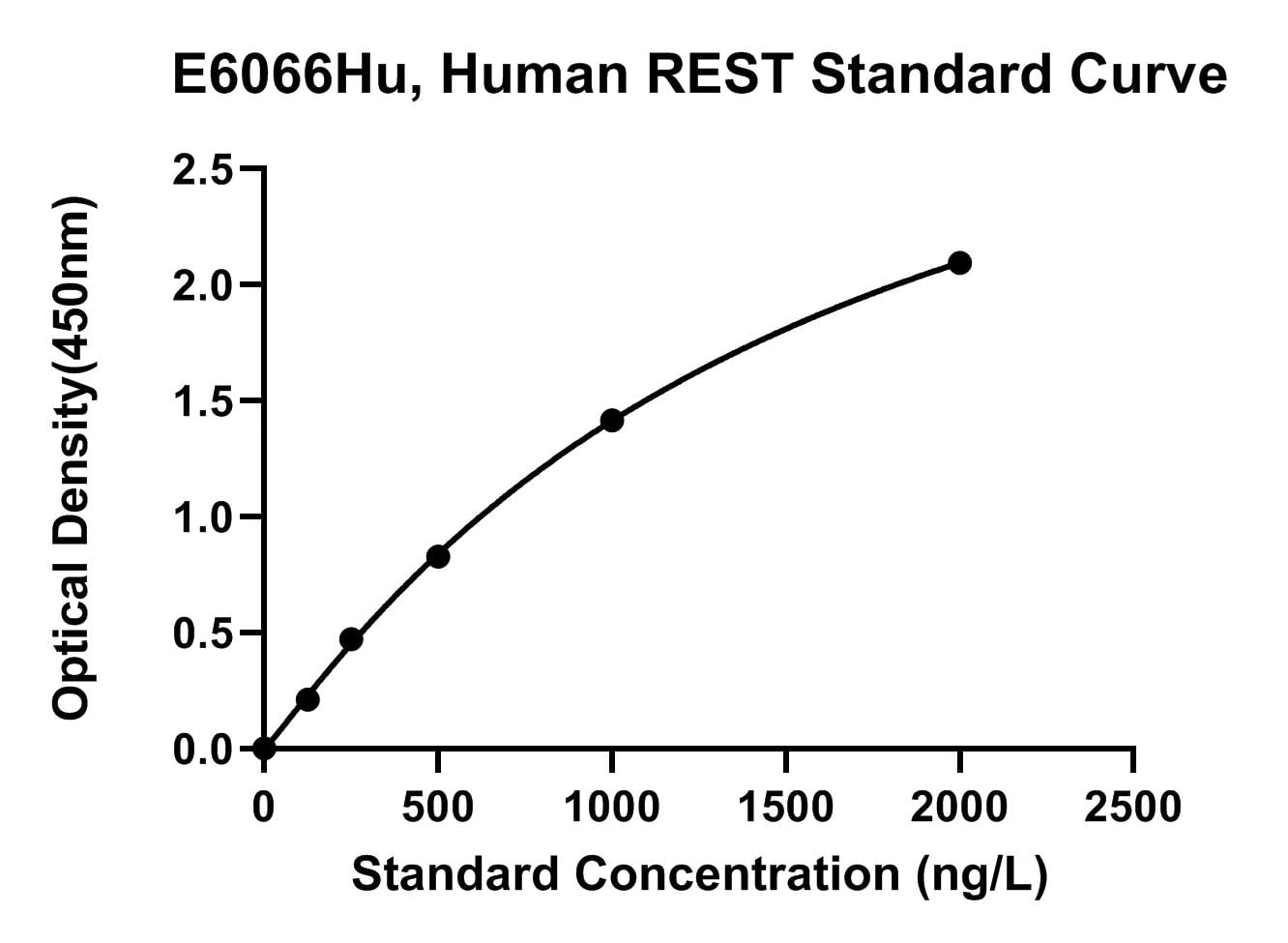
The Human (REST) Re1-silencing Transcription Factor ELISA Kit measures Re1-Silencing Transcription Factor in samples. The plate has been pre-coated with Human REST antibody. REST present in the sample is added and binds to antibodies coated on the wells. And then biotinylated Human REST Antibody is added and binds to REST in the sample. Then Streptavidin-HRP is added and binds to the Biotinylated REST antibody. After incubation unbound Streptavidin-HRP is washed away during a washing step. Substrate solution is then added and color develops in proportion to the amount of Human REST. The reaction is terminated by addition of acidic stop solution and absorbance is measured at 450 nm.
Catalog No:
E6066Hu
Regular price
$595.00 USD
Regular price
$458.00 USD
Sale price
$595.00 USD
Unit price
/
per
2.5 weeks
Couldn't load pickup availability
Product Details
Species Reactivity
Human
Sensitivity
8.96 ng/L
Detection Range
20-3500 ng/L
Sample Type
Serum, plasma, cell culture supernates
Incubation(s)
1.5 hour(s)
Research Areas
Epigenetics and Nuclear Signaling
Background
Transcriptional repressor which binds neuron-restrictive silencer element (NRSE) and represses neuronal gene transcription in non-neuronal cells (PubMed: 12399542, PubMed: 26551668, PubMed: 7697725, PubMed: 7871435, PubMed: 8568247, PubMed: 11741002, PubMed: 11779185). Restricts the expression of neuronal genes by associating with two distinct corepressors, SIN3A and RCOR1, which in turn recruit histone deacetylase to the promoters of REST-regulated genes (PubMed: 10449787, PubMed: 10734093). Mediates repression by recruiting the BHC complex at RE1/NRSE sites which acts by deacetylating and demethylating specific sites on histones, thereby acting as a chromatin modifier (By similarity). Transcriptional repression by REST-CDYL via the recruitment of histone methyltransferase EHMT2 may be important in transformation suppression (PubMed: 19061646). Represses the expression of SRRM4 in non-neural cells to prevent the activation of neural-specific splicing events and to prevent production of REST isoform 3 (By similarity). Repressor activity may be inhibited by forming heterodimers with isoform 3, thereby preventing binding to NRSE or binding to corepressors and leading to derepression of target genes (PubMed: 11779185). Also maintains repression of neuronal genes in neural stem cells, and allows transcription and differentiation into neurons by dissociation from RE1/NRSE sites of target genes (By similarity). Thereby is involved in maintaining the quiescent state of adult neural stem cells and preventing premature differentiation into mature neurons (PubMed: 21258371). Plays a role in the developmental switch in synaptic NMDA receptor composition during postnatal development, by repressing GRIN2B expression and thereby altering NMDA receptor properties from containing primarily GRIN2B to primarily GRIN2A subunits (By similarity). Acts as a regulator of osteoblast differentiation (By similarity). Key repressor of gene expression in hypoxia; represses genes in hypoxia by direct binding to an RE1/NRSE site on their promoter regions (PubMed: 27531581). May also function in stress resistance in the brain during aging; possibly by regulating expression of genes involved in cell death and in the stress response (PubMed: 24670762). Repressor of gene expression in the hippocampus after ischemia by directly binding to RE1/NRSE sites and recruiting SIN3A and RCOR1 to promoters of target genes, thereby promoting changes in chromatin modifications and ischemia-induced cell death (By similarity). After ischemia, might play a role in repression of miR-132 expression in hippocampal neurons, thereby leading to neuronal cell death (By similarity). Negatively regulates the expression of SRRM3 in breast cancer cell lines (PubMed: 26053433). [Isoform 3]: Binds to the 3' region of the neuron-restrictive silencer element (NRSE), with lower affinity than full-length REST isoform 1 (By similarity). Exhibits weaker repressor activity compared to isoform 1 (PubMed: 11779185). May negatively regulate the repressor activity of isoform 1 by binding to isoform 1, thereby preventing its binding to NRSE and leading to derepression of target genes (PubMed: 11779185). However, in another study, does not appear to be implicated in repressor activity of a NRSE motif-containing reporter construct nor in inhibitory activity on the isoform 1 transcriptional repressor activity (PubMed: 11741002). Post-transcriptional inactivation of REST by SRRM4-dependent alternative splicing into isoform 3 is required in mechanosensory hair cells in the inner ear for derepression of neuronal genes and hearing (By similarity). Source: UniProt Consortium (2025)
Shipping Condition
Shipped on cold gel packs.
Storage Condition and Shelf Life
2-8C
Analyte
Re1-Silencing Transcription Factor
Regulatory Status
For Research Use Only