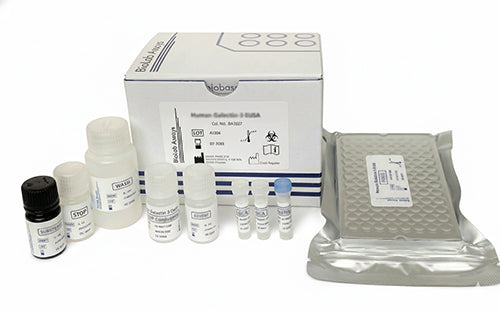
The Osteopontin ELISA is an enzyme immunoassay for the quantitative determination of Osteopontin in human serum and plasma.
The microtiter plate is coated with the antibody specifically binding the Osteopontin. The human serum or plasma is incubated in the plate with the capture antibody. The specimen is washed out and the specifically bound protein is incubated with biotin-labelled detection antibody. Following another washing step, Streptavidin-HRP conjugate is added into the well. Unbound reagent is then washed out. Horseradish peroxidase (HRP) bound in the complex reacts with the chromogenic substrate (TMB) creating the blue colour. The reaction is stopped by addition of STOP solution (H2SO4). The absorbance values are measured at 450 nm (optionally 450/630 nm) and are proportional to the concentration of Osteopontin in the specimen. The concentration of Osteopontin in unknown samples is determined from the calibration curve which is created by plotting the absorbance values against the standard concentration values.
Vendor: BioLab Assays
Catalog No:BA1028
Regular price
$560.00 USD
Regular price
$560.00 USD
Sale price
$560.00 USD
Unit price/ per
Sale
Sold out
2 weeks
Couldn't load pickup availability
Product Details
VendorBioLab Assays
Species ReactivityHuman
Sensitivity0.78 ng/mL
Detection Range125 - 4000 pg/mL
Sample TypeSerum, Plasma
Sample Size6 uL
Incubation(s)4.5 hour(s)
Research AreasAutoimmunity
BackgroundOsteopontin (OPN), a secreted multifunctional phosphoprotein, is a member of the small integrin-binding ligand N-linked glycoprotein (SIBLING) family of cell matrix proteins and participates in many biological activities. OPN has been demonstrated to be closely related to the occurrence and development of many bone-related diseases, such as osteoporosis, rheumatoid arthritis, and osteosarcoma. Besides that, it functions as a proinflammatory cytokine and promotes cell-mediated immune responses, and also has protective functions such as biomineralization and wound healing, and is also a strong predictor of adverse outcomes in patients with CVDs. Thus, OPN is not only a risk factor but also a potential therapeutic target for CVDs.