1
/
of
1
Human CADM1 (Cell Adhesion Molecule 1) ELISA Kit
Human CADM1 (Cell Adhesion Molecule 1) ELISA Kit
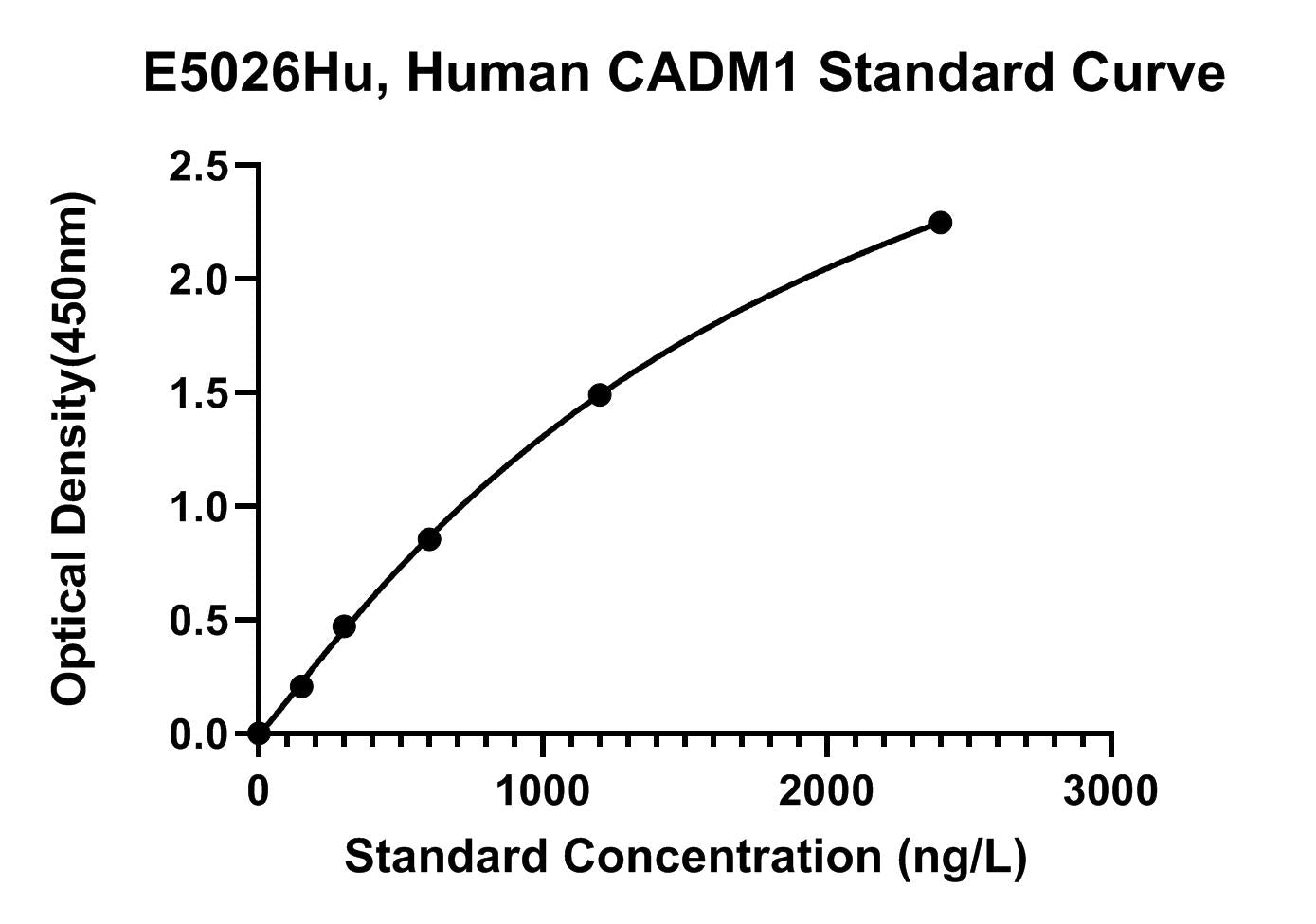
The Human (CADM1) Cell Adhesion Molecule 1 ELISA Kit measures Cell Adhesion Molecule 1 in samples. The plate has been pre-coated with Human CADM1 antibody. CADM1 present in the sample is added and binds to antibodies coated on the wells. And then biotinylated Human CADM1 Antibody is added and binds to CADM1 in the sample. Then Streptavidin-HRP is added and binds to the Biotinylated CADM1 antibody. After incubation unbound Streptavidin-HRP is washed away during a washing step. Substrate solution is then added and color develops in proportion to the amount of Human CADM1. The reaction is terminated by addition of acidic stop solution and absorbance is measured at 450 nm.
Catalog No:
E5026Hu
Regular price
$595.00 USD
Regular price
$458.00 USD
Sale price
$595.00 USD
Unit price
/
per
2.5 weeks
Couldn't load pickup availability
Product Details
Species Reactivity
Human
Sensitivity
9.53 ng/L
Detection Range
20-4500 ng/L
Sample Type
Serum, plasma, cell culture supernates
Incubation(s)
1.5 hour(s)
Research Areas
Neuroscience, CD & Adhesion molecule
Background
Mediates homophilic cell-cell adhesion in a Ca(2+)-independent manner (PubMed: 22438059, PubMed: 12050160). Also mediates heterophilic cell-cell adhesion with CADM3 and NECTIN3 in a Ca(2+)-independent manner (By similarity). Interaction with CRTAM promotes natural killer (NK) cell cytotoxicity and interferon-gamma (IFN-gamma) secretion by CD8+ cells in vitro as well as NK cell-mediated rejection of tumors expressing CADM1 in vivo (PubMed: 15811952). In mast cells, may mediate attachment to and promote communication with nerves (PubMed: 15905536). CADM1, together with MITF, is essential for development and survival of mast cells in vivo (PubMed: 22438059). By interacting with CRTAM and thus promoting the adhesion between CD8+ T-cells and CD8+ dendritic cells, regulates the retention of activated CD8+ T-cell within the draining lymph node (By similarity). Required for the intestinal retention of intraepithelial CD4+ CD8+ T-cells and, to a lesser extent, intraepithelial and lamina propria CD8+ T-cells and CD4+ T-cells (By similarity). Interaction with CRTAM promotes the adhesion to gut-associated CD103+ dendritic cells, which may facilitate the expression of gut-homing and adhesion molecules on T-cells and the conversion of CD4+ T-cells into CD4+ CD8+ T-cells (By similarity). Acts as a synaptic cell adhesion molecule and plays a role in the formation of dendritic spines and in synapse assembly (By similarity). May be involved in neuronal migration, axon growth, pathfinding, and fasciculation on the axons of differentiating neurons (By similarity). May play diverse roles in the spermatogenesis including in the adhesion of spermatocytes and spermatids to Sertoli cells and for their normal differentiation into mature spermatozoa (By similarity). Acts as a tumor suppressor in non-small-cell lung cancer (NSCLC) cells (PubMed: 11279526, PubMed: 12234973). May contribute to the less invasive phenotypes of lepidic growth tumor cells (PubMed: 12920246). Source: UniProt Consortium (2025)
Shipping Condition
Shipped on cold gel packs.
Storage Condition and Shelf Life
2-8C
Analyte
Cell Adhesion Molecule 1
Regulatory Status
For Research Use Only