1
/
of
1
Human CASP4 (Caspase-4) ELISA Kit
Human CASP4 (Caspase-4) ELISA Kit
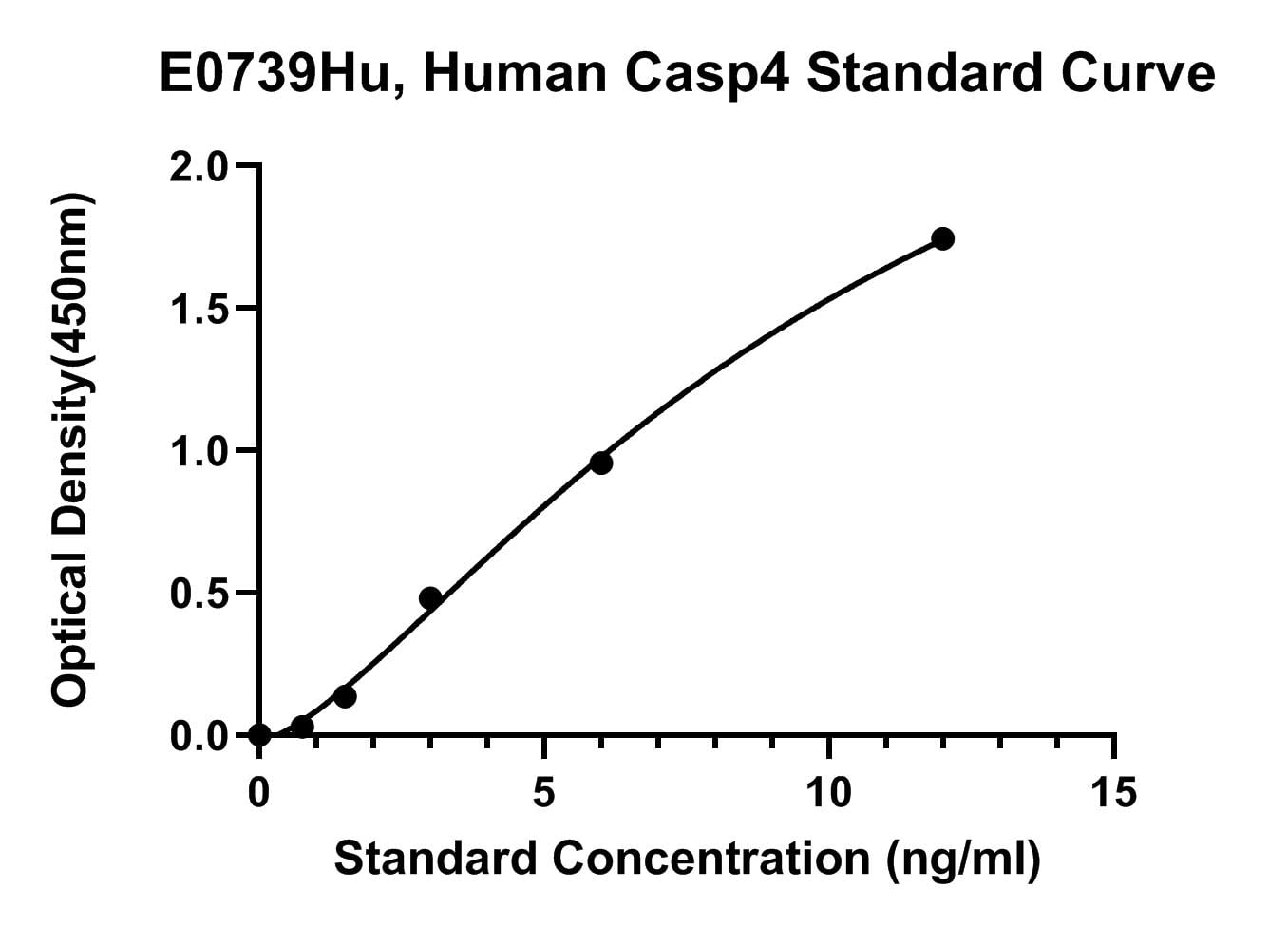
The Human (CASP4) Caspase-4 ELISA Kit measures Caspase-4 in samples. The plate has been pre-coated with Human CASP4 antibody. CASP4 present in the sample is added and binds to antibodies coated on the wells. And then biotinylated Human CASP4 Antibody is added and binds to CASP4 in the sample. Then Streptavidin-HRP is added and binds to the Biotinylated CASP4 antibody. After incubation unbound Streptavidin-HRP is washed away during a washing step. Substrate solution is then added and color develops in proportion to the amount of Human CASP4. The reaction is terminated by addition of acidic stop solution and absorbance is measured at 450 nm.
Catalog No:
E0739Hu
Regular price
$595.00 USD
Regular price
$458.00 USD
Sale price
$595.00 USD
Unit price
/
per
2.5 weeks
Couldn't load pickup availability
Product Details
Species Reactivity
Human
Sensitivity
0.022 ng/mL
Detection Range
0.05-20 ng/mL
Sample Type
Serum, plasma, cell culture supernates
Incubation(s)
1.5 hour(s)
Research Areas
Apoptosis
Background
Inflammatory caspase that acts as an essential effector of NLRP3 inflammasome-dependent CASP1 activation and IL1B and IL18 secretion in response to non-canonical activators, such as UVB radiation, cholera enterotoxin subunit B and cytosolic LPS (PubMed: 23516580, PubMed: 24879791, PubMed: 25119034, PubMed: 22246630, PubMed: 26174085, PubMed: 26173988, PubMed: 26508369, PubMed: 25964352). Thiol protease that cleaves a tetrapeptide after an Asp residue at position P1 (PubMed: 7797510, PubMed: 23516580). Independently of NLRP3 inflammasome and CASP1, promotes pyroptosis, through GSDMD cleavage and activation, followed by IL1A, IL18 and HMGB1 release in response to non-canonical inflammasome activators (PubMed: 26375003, PubMed: 32109412). Plays a crucial role in the restriction of Salmonella typhimurium replication in colonic epithelial cells during infection: in later stages of the infection, LPS from cytosolic Salmonella triggers CASP4 activation, which catalyzes cleavage of GSDMD, resulting in pyroptosis of infected cells and their extrusion into the gut lumen, as well as in IL18 secretion (PubMed: 25121752, PubMed: 26375003, PubMed: 25964352, PubMed: 32109412). Cleavage of GSDMD is not strictly dependent on the consensus cleavage site but depends on an exosite interface on CASP4 that recognizes and binds the Gasdermin-D, C-terminal (GSDMD-CT) part (PubMed: 32109412). Pyroptosis limits bacterial replication, while cytokine secretion promotes the recruitment and activation of immune cells and triggers mucosal inflammation (PubMed: 25121752, PubMed: 26375003, PubMed: 25964352). Involved in LPS-induced IL6 secretion; this activity may not require caspase enzymatic activity (PubMed: 26508369). Involved in cell death induced by endoplasmic reticulum stress and by treatment with cytotoxic APP Peptides found Alzheimer's patient brains (PubMed: 15123740, PubMed: 22246630, PubMed: 23661706). Activated by direct binding to LPS without the need of an upstream sensor (PubMed: 25119034). Does not directly process IL1B (PubMed: 7743998, PubMed: 7797510, PubMed: 7797592). During non-canonical inflammasome activation, cuts CGAS and may play a role in the regulation of antiviral innate immune activation (PubMed: 28314590). Source: UniProt Consortium (2025)
Shipping Condition
Shipped on cold gel packs.
Storage Condition and Shelf Life
2-8C
Analyte
Caspase-4
Regulatory Status
For Research Use Only