1
/
of
1
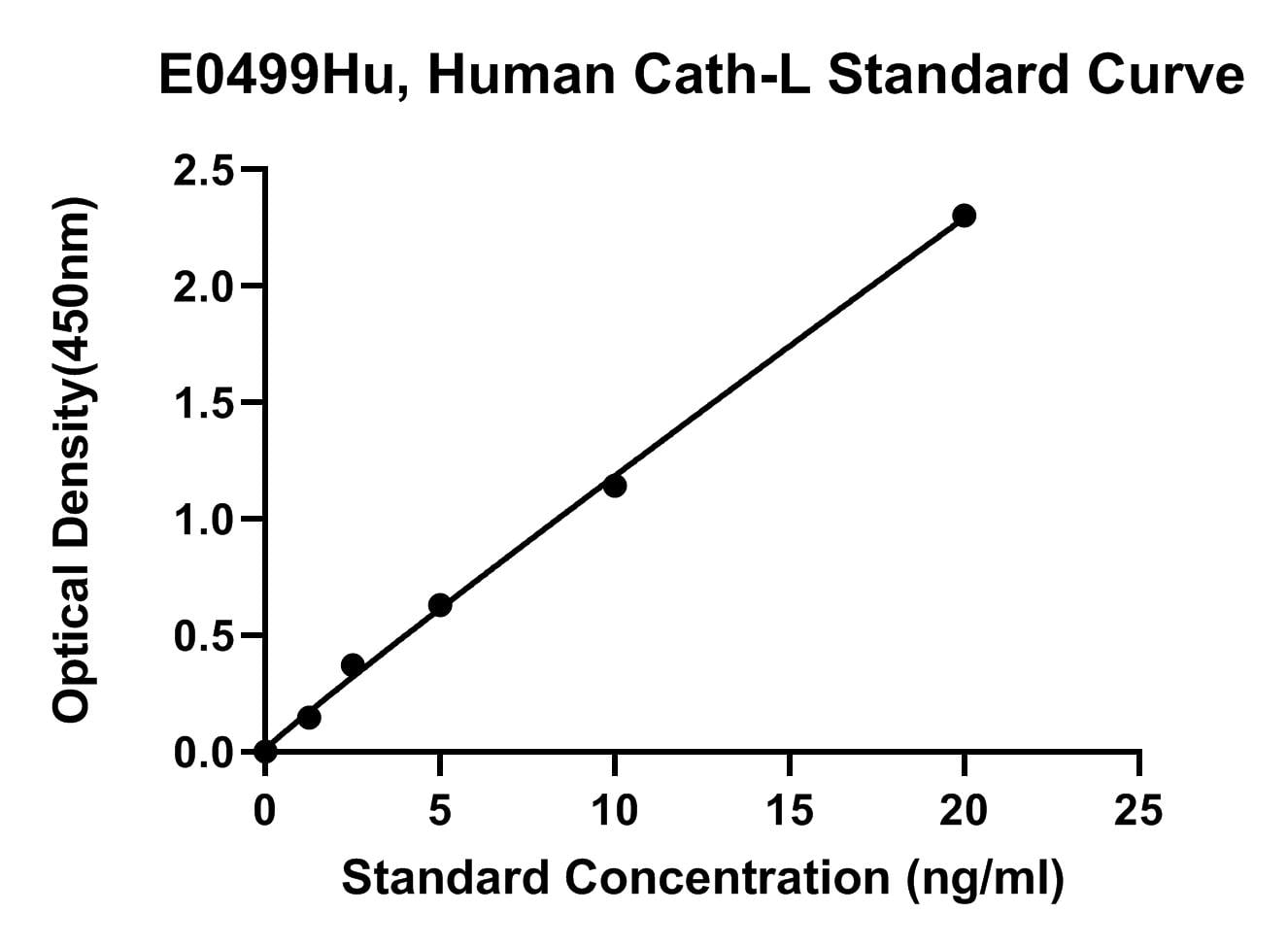
Human CATH-L (Cathepsin L) ELISA Kit
Human CATH-L (Cathepsin L) ELISA Kit
The Human (CATH-L) Cathepsin L ELISA Kit measures Cathepsin L in samples.
Catalog No:
E0499Hu
Regular price
$595.00 USD
Regular price
$458.00 USD
Sale price
$595.00 USD
Unit price
/
per
2.5 weeks
Couldn't load pickup availability
Product Details
Species Reactivity
Human
Sensitivity
0.04 ng/mL
Detection Range
0.1-38 ng/mL
Sample Type
Serum, plasma, cell culture supernates
Incubation(s)
1.5 hour(s)
Research Areas
Signal Transduction
Background
Thiol protease important for the overall degradation of proteins in lysosomes (Probable). Plays a critical for normal cellular functions such as general protein turnover, antigen processing and bone remodeling. Involved in the solubilization of cross-linked TG/thyroglobulin and in the subsequent release of thyroid hormone thyroxine (T4) by limited proteolysis of TG/thyroglobulin in the thyroid follicle lumen (By similarity). In neuroendocrine chromaffin cells secretory vesicles, catalyzes the prohormone proenkephalin processing to the active enkephalin Peptide neurotransmitter (By similarity). In thymus, regulates CD4(+) T cell positive selection by generating the major histocompatibility complex class II (MHCII) bound Peptide ligands presented by cortical thymic epithelial cells. Also mediates invariant chain processing in cortical thymic epithelial cells (By similarity). Major elastin-degrading enzyme at neutral pH. Accumulates as a mature and active enzyme in the extracellular space of antigen presenting cells (APCs) to regulate degradation of the extracellular matrix in the course of inflammation (By similarity). Secreted form generates endostatin from COL18A1 (PubMed: 10716919). Critical for cardiac morphology and function. Plays an important role in hair follicle morphogenesis and cycling, as well as epidermal differentiation (By similarity). Required for maximal stimulation of steroidogenesis by TIMP1 (By similarity). [Isoform 2]: Functions in the regulation of cell cycle progression through proteolytic processing of the CUX1 transcription factor (PubMed: 15099520). Translation initiation at downstream start sites allows the synthesis of isoforms that are devoid of a signal Peptide and localize to the nucleus where they cleave the CUX1 transcription factor and modify its DNA binding properties (PubMed: 15099520). (Microbial infection) Facilitates human coronaviruses SARS-CoV and SARS-CoV-2 infections via proteolysis of coronavirus spike (S) glycoproteins in lysosome for entry into host cell (PubMed: 32142651, PubMed: 32221306, PubMed: 16339146, PubMed: 18562523). Proteolysis within lysosomes is sufficient to activate membrane fusion by coronaviruses SARS-CoV and EMC (HCoV-EMC) S as well as Zaire ebolavirus glycoproteins (PubMed: 16081529, PubMed: 26953343, PubMed: 18562523). Source: UniProt Consortium (2025)
Shipping Condition
Shipped on cold gel packs.
Storage Condition and Shelf Life
2-8C
Analyte
Cathepsin L
Regulatory Status
For Research Use Only