1
/
of
1
Human CCL5/RANTES (C-C Motif Chemokine 5) ELISA Kit
Human CCL5/RANTES (C-C Motif Chemokine 5) ELISA Kit
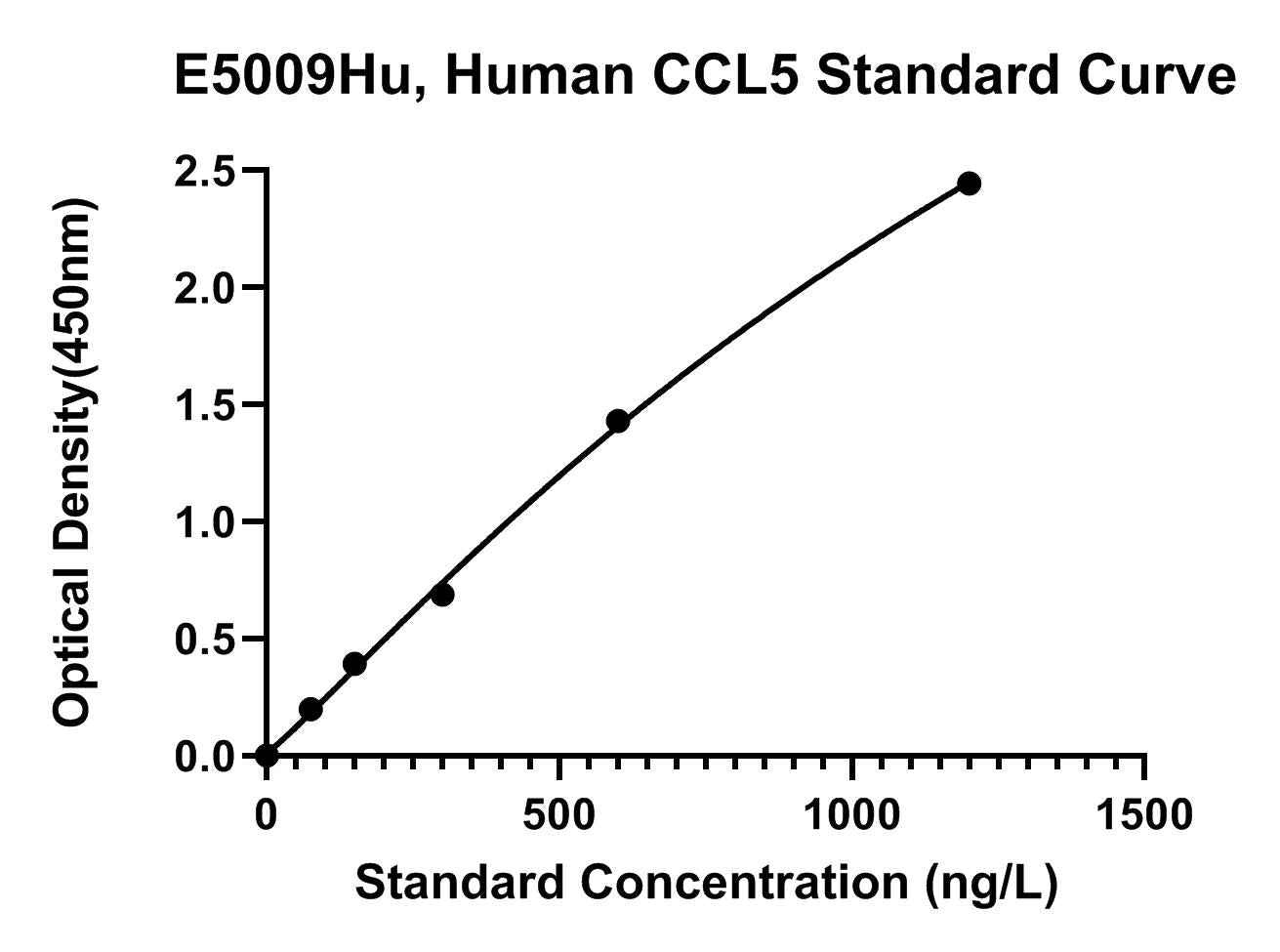
The Human (CCL5/RANTES) C-C Motif Chemokine 5 ELISA Kit measures C-C Motif Chemokine 5 in samples. The plate has been pre-coated with Human CCL5 antibody. CCL5 present in the sample is added and binds to antibodies coated on the wells. And then biotinylated Human CCL5 Antibody is added and binds to CCL5 in the sample. Then Streptavidin-HRP is added and binds to the Biotinylated CCL5 antibody. After incubation unbound Streptavidin-HRP is washed away during a washing step. Substrate solution is then added and color develops in proportion to the amount of Human CCL5. The reaction is terminated by addition of acidic stop solution and absorbance is measured at 450 nm.
Catalog No:
E5009Hu
Regular price
$595.00 USD
Regular price
$458.00 USD
Sale price
$595.00 USD
Unit price
/
per
2.5 weeks
Couldn't load pickup availability
Product Details
Species Reactivity
Human
Sensitivity
5.26 ng/L
Detection Range
10-2000 ng/L
Sample Type
Serum, plasma, cell culture supernates
Incubation(s)
1.5 hour(s)
Research Areas
Immunology, Cardiovascular
Background
Chemoattractant for blood monocytes, memory T-helper cells and eosinophils. Causes the release of histamine from basophils and activates eosinophils. May activate several chemokine receptors including CCR1, CCR3, CCR4 and CCR5. One of the major HIV-suppressive factors produced by CD8+ T-cells. Recombinant RANTES protein induces a dose-dependent inhibition of different strains of HIV-1, HIV-2, and simian immunodeficiency virus (SIV). The processed form RANTES(3-68) acts as a natural chemotaxis inhibitor and is a more potent inhibitor of HIV-1-infection. The second processed form RANTES(4-68) exhibits reduced chemotactic and HIV-suppressive activity compared with RANTES(1-68) and RANTES(3-68) and is generated by an unidentified enzyme associated with monocytes and neutrophils (PubMed: 16791620, PubMed: 1380064, PubMed: 8525373, PubMed: 9516414, PubMed: 15923218). May also be an agonist of the G protein-coupled receptor GPR75, stimulating inositol trisphosphate production and calcium mobilization through its activation. Together with GPR75, may play a role in neuron survival through activation of a downstream signaling pathway involving the PI3, Akt and MAP kinases. By activating GPR75 may also play a role in insulin secretion by islet cells (PubMed: 23979485). Source: UniProt Consortium (2025)
Shipping Condition
Shipped on cold gel packs.
Storage Condition and Shelf Life
2-8C
Analyte
C-C Motif Chemokine 5
Regulatory Status
For Research Use Only