1
/
of
1
Human CDK9 (Cyclin Dependent Kinase 9) ELISA Kit
Human CDK9 (Cyclin Dependent Kinase 9) ELISA Kit
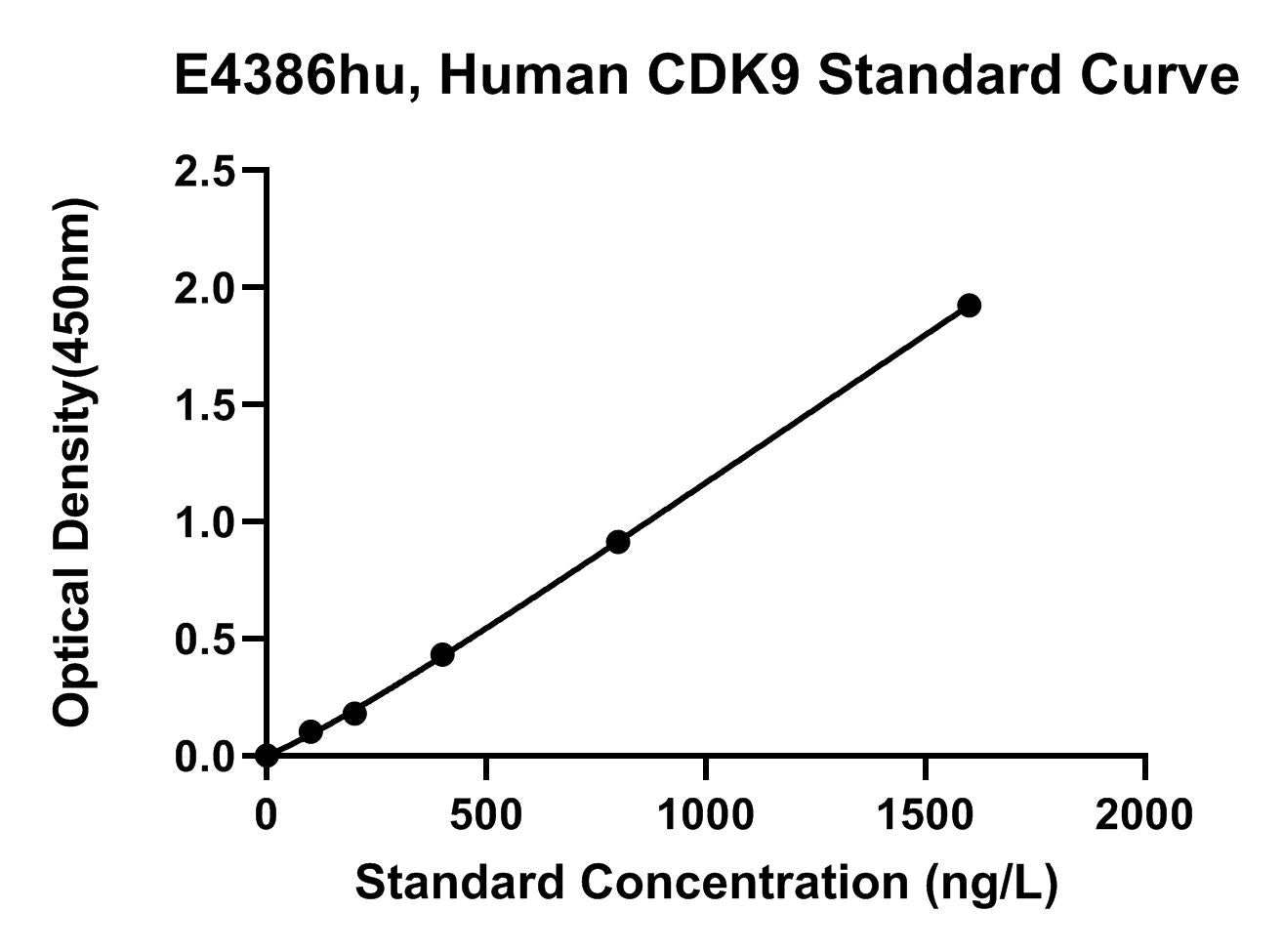
The Human (CDK9) Cyclin Dependent Kinase 9 ELISA Kit measures Cyclin Dependent Kinase 9 in samples. The plate has been pre-coated with Human CDK9 antibody. CDK9 present in the sample is added and binds to antibodies coated on the wells. And then biotinylated Human CDK9 Antibody is added and binds to CDK9 in the sample. Then Streptavidin-HRP is added and binds to the Biotinylated CDK9 antibody. After incubation unbound Streptavidin-HRP is washed away during a washing step. Substrate solution is then added and color develops in proportion to the amount of Human CDK9. The reaction is terminated by addition of acidic stop solution and absorbance is measured at 450 nm.
Catalog No:
E4386hu
Regular price
$595.00 USD
Regular price
$458.00 USD
Sale price
$595.00 USD
Unit price
/
per
2.5 weeks
Couldn't load pickup availability
Product Details
Species Reactivity
Human
Sensitivity
7.56 ng/L
Detection Range
15-3000 ng/L
Sample Type
Serum, plasma, cell culture supernates
Incubation(s)
1.5 hour(s)
Research Areas
Cell Biology, Microbiology, Epigenetics and Nuclear Signaling, Immunology, Enzyme & Kinase
Background
Protein kinase involved in the regulation of transcription (PubMed: 10574912, PubMed: 10757782, PubMed: 11145967, PubMed: 11575923, PubMed: 11809800, PubMed: 11884399, PubMed: 14701750, PubMed: 16109376, PubMed: 16109377, PubMed: 20930849, PubMed: 28426094). Member of the cyclin-dependent kinase pair (CDK9/cyclin-T) complex, also called positive transcription elongation factor b (P-TEFb), which facilitates the transition from abortive to productive elongation by phosphorylating the CTD (C-terminal domain) of the large subunit of RNA polymerase II (RNAP II) POLR2A, SUPT5H and RDBP (PubMed: 10574912, PubMed: 10757782, PubMed: 11145967, PubMed: 11575923, PubMed: 11809800, PubMed: 11884399, PubMed: 14701750, PubMed: 16109376, PubMed: 16109377, PubMed: 20930849, PubMed: 28426094). This complex is inactive when in the 7SK snRNP complex form (PubMed: 10574912, PubMed: 10757782, PubMed: 11145967, PubMed: 11575923, PubMed: 11809800, PubMed: 11884399, PubMed: 14701750, PubMed: 16109376, PubMed: 16109377, PubMed: 20930849, PubMed: 28426094). Phosphorylates EP300, MYOD1, RPB1/POLR2A and AR and the negative elongation factors DSIF and NELF (PubMed: 9857195, PubMed: 10912001, PubMed: 11112772, PubMed: 12037670, PubMed: 20081228, PubMed: 20980437, PubMed: 21127351). Regulates cytokine inducible transcription networks by facilitating promoter recognition of target transcription factors (e.g. TNF-inducible RELA/p65 activation and IL-6-inducible STAT3 signaling) (PubMed: 17956865, PubMed: 18362169). Promotes RNA synthesis in genetic programs for cell growth, differentiation and viral pathogenesis (PubMed: 10393184, PubMed: 11112772). P-TEFb is also involved in cotranscriptional histone modification, mRNA processing and mRNA export (PubMed: 15564463, PubMed: 19575011, PubMed: 19844166). Modulates a complex network of chromatin modifications including histone H2B monoubiquitination (H2Bub1), H3 lysine 4 trimethylation (H3K4me3) and H3K36me3; integrates phosphorylation during transcription with chromatin modifications to control co-transcriptional histone mRNA processing (PubMed: 15564463, PubMed: 19575011, PubMed: 19844166). The CDK9/cyclin-K complex has also a kinase activity towards CTD of RNAP II and can substitute for CDK9/cyclin-T P-TEFb in vitro (PubMed: 21127351). Replication stress response protein; the CDK9/cyclin-K complex is required for genome integrity maintenance, by promoting cell cycle recovery from replication arrest and limiting single-stranded DNA amount in response to replication stress, thus reducing the breakdown of stalled replication forks and avoiding DNA damage (PubMed: 20493174). In addition, probable function in DNA repair of isoform 2 via interaction with KU70/XRCC6 (PubMed: 20493174). Promotes cardiac myocyte enlargement (PubMed: 20081228). RPB1/POLR2A phosphorylation on 'Ser-2' in CTD activates transcription (PubMed: 21127351). AR phosphorylation modulates AR transcription factor promoter selectivity and cell growth. DSIF and NELF phosphorylation promotes transcription by inhibiting their negative effect (PubMed: 9857195, PubMed: 10912001, PubMed: 11112772). The phosphorylation of MYOD1 enhances its transcriptional activity and thus promotes muscle differentiation (PubMed: 12037670). Source: UniProt Consortium (2025)
Shipping Condition
Shipped on cold gel packs.
Storage Condition and Shelf Life
2-8C
Analyte
Cyclin Dependent Kinase 9
Regulatory Status
For Research Use Only