1
/
of
1
Human CLU (Clusterin) ELISA Kit
Human CLU (Clusterin) ELISA Kit
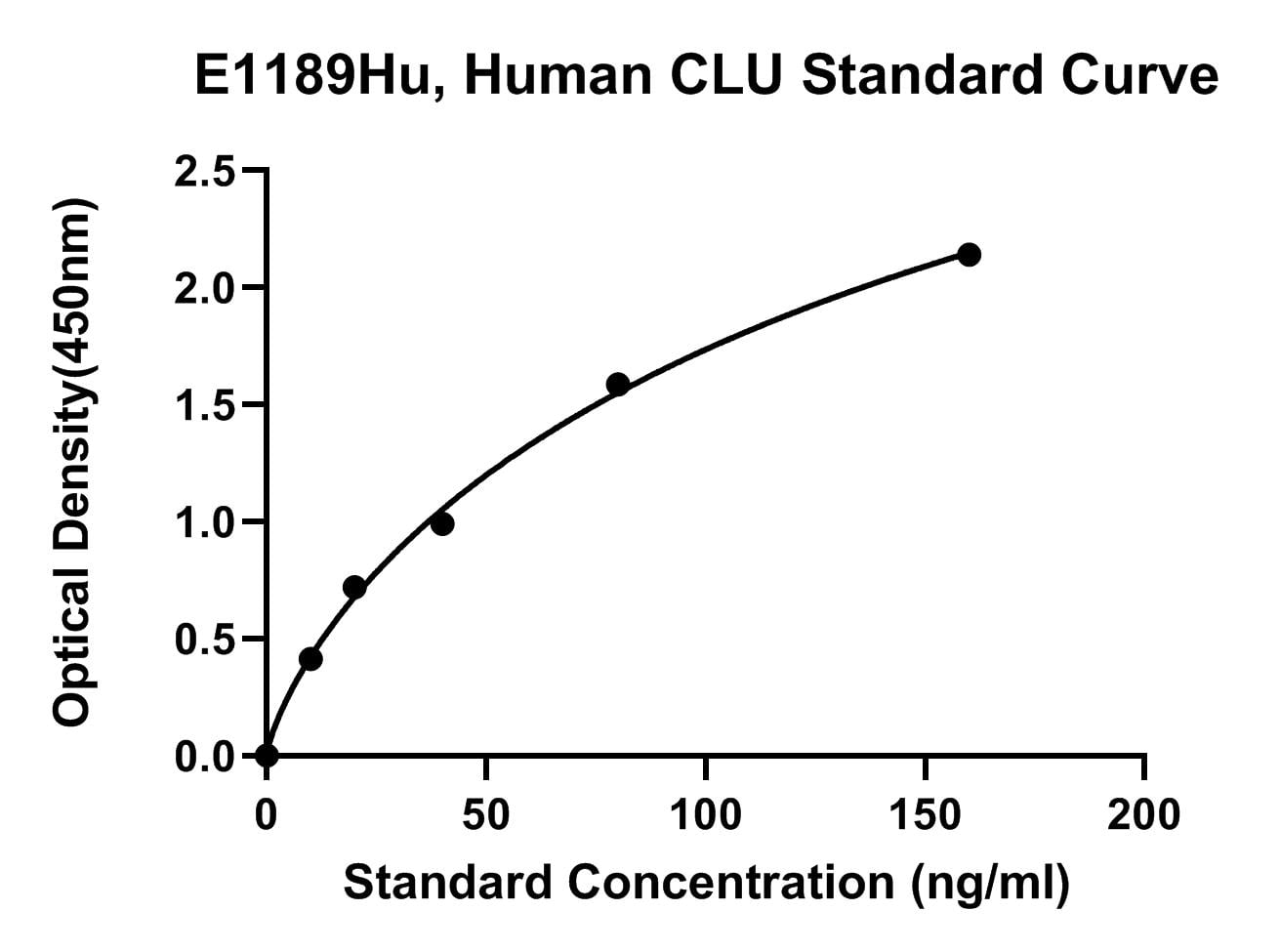
The Human (CLU) Clusterin ELISA Kit measures Clusterin in samples. The plate has been pre-coated with Human CLU antibody. CLU present in the sample is added and binds to antibodies coated on the wells. And then biotinylated Human CLU Antibody is added and binds to CLU in the sample. Then Streptavidin-HRP is added and binds to the Biotinylated CLU antibody. After incubation unbound Streptavidin-HRP is washed away during a washing step. Substrate solution is then added and color develops in proportion to the amount of Human CLU. The reaction is terminated by addition of acidic stop solution and absorbance is measured at 450 nm.
Catalog No:
E1189Hu
Regular price
$595.00 USD
Regular price
$458.00 USD
Sale price
$595.00 USD
Unit price
/
per
2.5 weeks
Couldn't load pickup availability
Product Details
Species Reactivity
Human
Sensitivity
0.31 ng/mL
Detection Range
0.5-300 ng/mL
Sample Type
Serum, plasma, cell culture supernates
Incubation(s)
1.5 hour(s)
Research Areas
Cardiovascular
Background
[Isoform 1]: Functions as extracellular chaperone that prevents aggregation of non native proteins (PubMed: 11123922, PubMed: 19535339). Prevents stress-induced aggregation of blood plasma proteins (PubMed: 11123922, PubMed: 12176985, PubMed: 17260971, PubMed: 19996109). Inhibits formation of amyloid fibrils by APP, APOC2, B2M, CALCA, CSN3, SNCA and aggregation-prone LYZ variants (in vitro) (PubMed: 12047389, PubMed: 17412999, PubMed: 17407782). Does not require ATP (PubMed: 11123922). Maintains partially unfolded proteins in a state appropriate for subsequent refolding by other chaperones, such as HSPA8/HSC70 (PubMed: 11123922). Does not refold proteins by itself (PubMed: 11123922). Binding to cell surface receptors triggers internalization of the chaperone-client complex and subsequent lysosomal or proteasomal degradation (PubMed: 21505792). Protects cells against apoptosis and against cytolysis by complement (PubMed: 2780565). Intracellular forms interact with ubiquitin and SCF (SKP1-CUL1-F-box protein) E3 ubiquitin-protein ligase complexes and promote the ubiquitination and subsequent proteasomal degradation of target proteins (PubMed: 20068069). Promotes proteasomal degradation of COMMD1 and IKBKB (PubMed: 20068069). Modulates NF-kappa-B transcriptional activity (PubMed: 12882985). A mitochondrial form suppresses BAX-dependent release of cytochrome c into the cytoplasm and inhibit apoptosis (PubMed: 16113678, PubMed: 17689225). Plays a role in the regulation of cell proliferation (PubMed: 19137541). An intracellular form suppresses stress-induced apoptosis by stabilizing mitochondrial membrane integrity through interaction with HSPA5 (PubMed: 22689054). Secreted form does not affect caspase or BAX-mediated intrinsic apoptosis and TNF-induced NF-kappa-B-activity (PubMed: 24073260). Secreted form act as an important modulator during neuronal differentiation through interaction with STMN3 (By similarity). Plays a role in the clearance of immune complexes that arise during cell injury (By similarity). [Isoform 6]: Does not affect caspase or BAX-mediated intrinsic apoptosis and TNF-induced NF-kappa-B-activity. [Isoform 4]: Does not affect caspase or BAX-mediated intrinsic apoptosis and TNF-induced NF-kappa-B-activity (PubMed: 24073260). Promotes cell death through interaction with BCL2L1 that releases and activates BAX (PubMed: 21567405). Source: UniProt Consortium (2025)
Shipping Condition
Shipped on cold gel packs.
Storage Condition and Shelf Life
2-8C
Analyte
Clusterin
Regulatory Status
For Research Use Only