1
/
of
1
Human GDF6 (Growth Differentiation Factor 6) ELISA Kit
Human GDF6 (Growth Differentiation Factor 6) ELISA Kit
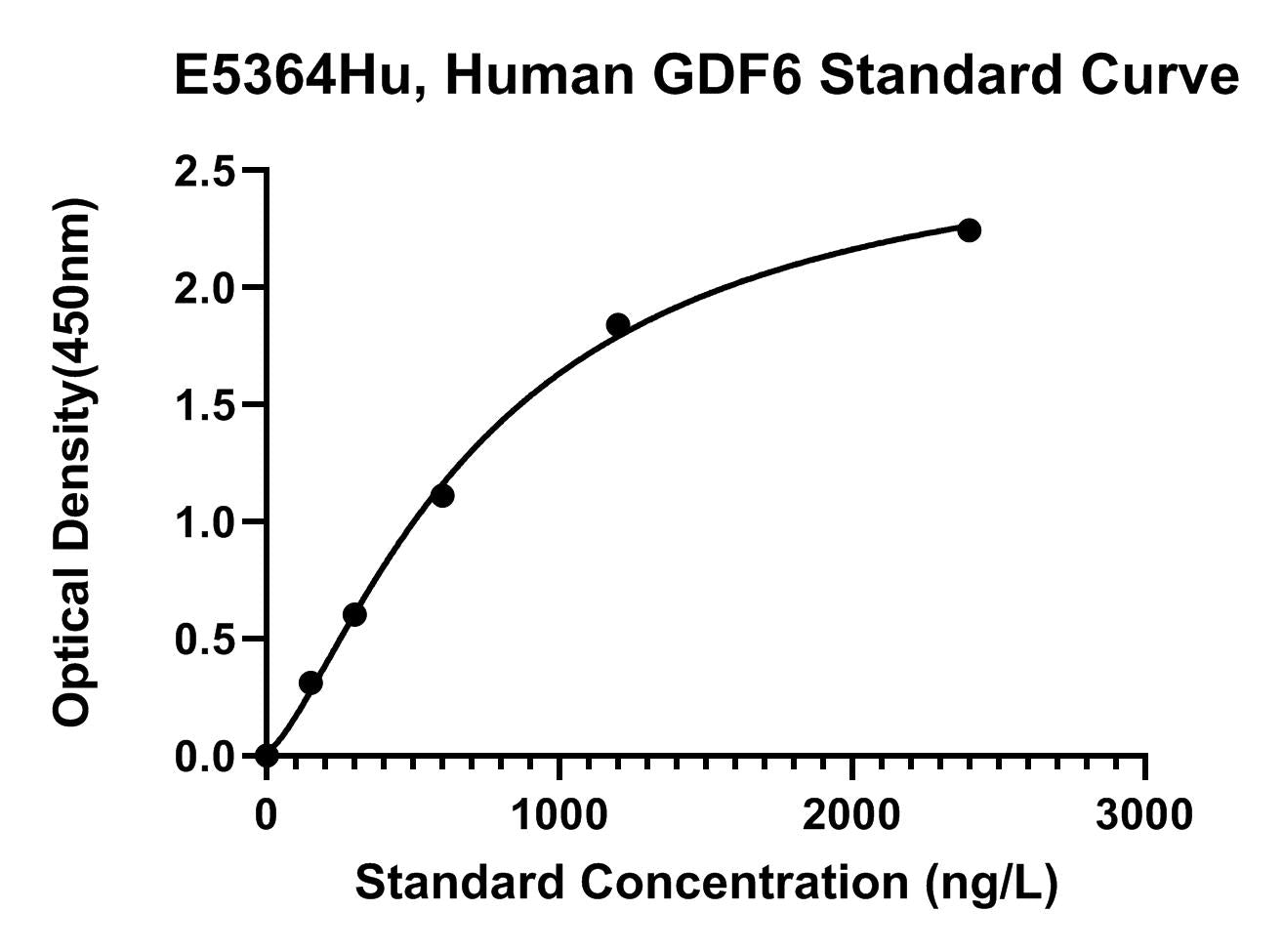
The Human (GDF6) Growth Differentiation Factor 6 ELISA Kit measures Growth/differentiation factor 6 in samples. The plate has been pre-coated with Human GDF6 antibody. GDF6 present in the sample is added and binds to antibodies coated on the wells. And then biotinylated Human GDF6 Antibody is added and binds to GDF6 in the sample. Then Streptavidin-HRP is added and binds to the Biotinylated GDF6 antibody. After incubation unbound Streptavidin-HRP is washed away during a washing step. Substrate solution is then added and color develops in proportion to the amount of Human GDF6. The reaction is terminated by addition of acidic stop solution and absorbance is measured at 450 nm.
Catalog No:
E5364Hu
Regular price
$595.00 USD
Regular price
$458.00 USD
Sale price
$595.00 USD
Unit price
/
per
2.5 weeks
Couldn't load pickup availability
Product Details
Species Reactivity
Human
Sensitivity
9.54 ng/L
Detection Range
20-4500 ng/L
Sample Type
Serum, plasma, cell culture supernates
Incubation(s)
1.5 hour(s)
Research Areas
Signal Transduction, Neuroscience
Background
Growth factor that controls proliferation and cellular differentiation in the retina and bone formation. Plays a key role in regulating apoptosis during retinal development. Establishes dorsal-ventral positional information in the retina and controls the formation of the retinotectal map (PubMed:23307924).
Required for normal formation of bones and joints in the limbs, skull, digits and axial skeleton. Plays a key role in establishing boundaries between skeletal elements during development. Regulation of GDF6 expression seems to be a mechanism for evolving species-specific changes in skeletal structures. Seems to positively regulate differentiation of chondrogenic tissue through the growth factor receptors subunits BMPR1A, BMPR1B, BMPR2 and ACVR2A, leading to the activation of SMAD1-SMAD5-SMAD8 complex. The regulation of chondrogenic differentiation is inhibited by NOG (PubMed:26643732).
Also involved in the induction of adipogenesis from mesenchymal stem cells. This mechanism acts through the growth factor receptors subunits BMPR1A, BMPR2 and ACVR2A and the activation of SMAD1-SMAD5-SMAD8 complex and MAPK14/p38 (By similarity). Source: UniProt Consortium (2025)
Shipping Condition
Shipped on cold gel packs.
Storage Condition and Shelf Life
2-8C
Analyte
Growth/differentiation factor 6
Regulatory Status
For Research Use Only