1
/
of
1
Human SYT7 (Synaptotagmin 7) ELISA Kit
Human SYT7 (Synaptotagmin 7) ELISA Kit
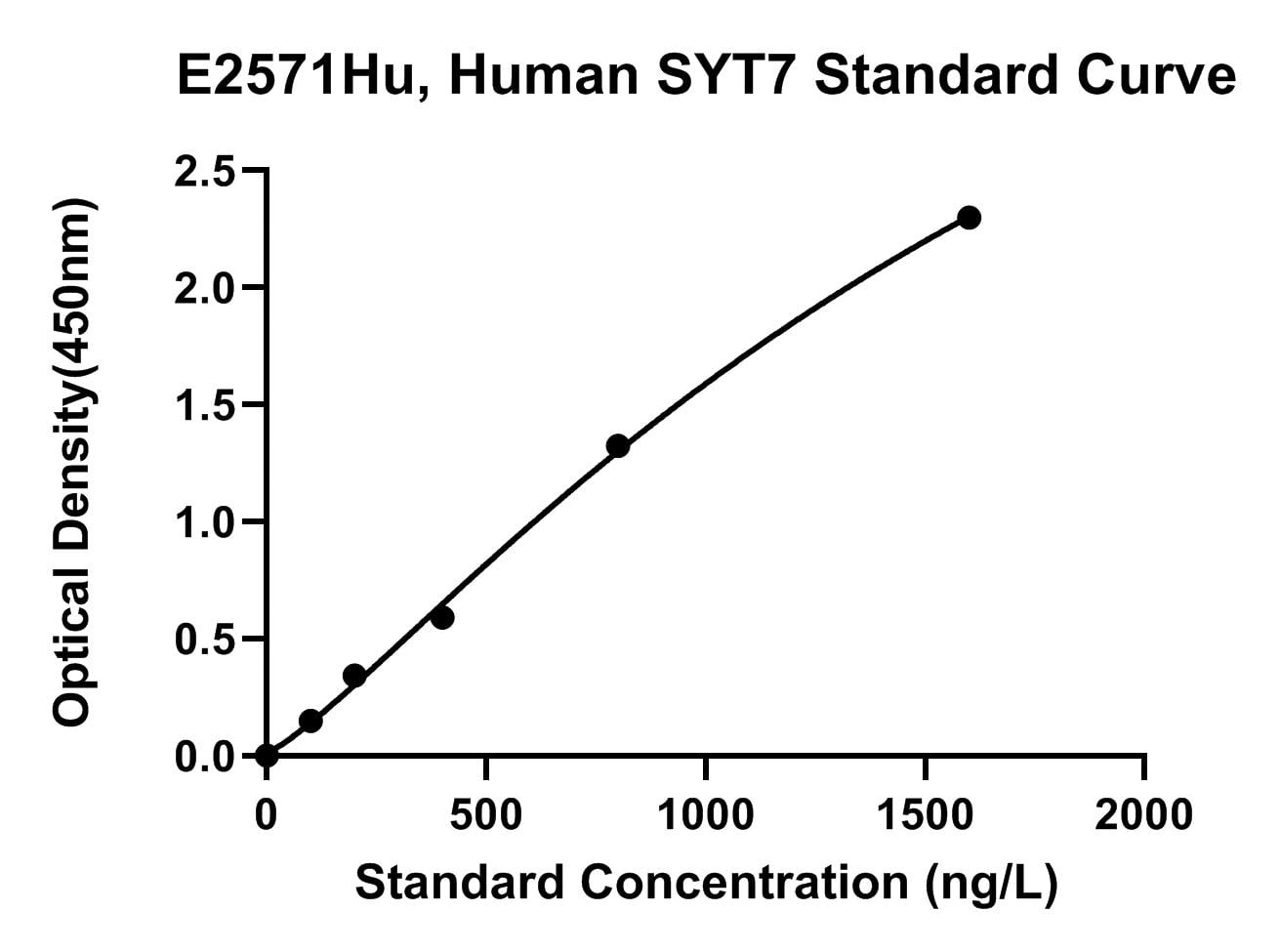
The Human (SYT7) Synaptotagmin 7 ELISA Kit measures Synaptotagmin 7 in samples. The plate has been pre-coated with Human SYT7 antibody. SYT7 present in the sample is added and binds to antibodies coated on the wells. And then biotinylated Human SYT7 Antibody is added and binds to SYT7 in the sample. Then Streptavidin-HRP is added and binds to the Biotinylated SYT7 antibody. After incubation unbound Streptavidin-HRP is washed away during a washing step. Substrate solution is then added and color develops in proportion to the amount of Human SYT7. The reaction is terminated by addition of acidic stop solution and absorbance is measured at 450 nm.
Catalog No:
E2571Hu
Regular price
$595.00 USD
Regular price
$458.00 USD
Sale price
$595.00 USD
Unit price
/
per
2.5 weeks
Couldn't load pickup availability
Product Details
Species Reactivity
Human
Sensitivity
8.14 ng/L
Detection Range
15-3000 ng/L
Sample Type
Serum, plasma, cell culture supernates
Incubation(s)
1.5 hour(s)
Research Areas
Neuroscience
Background
Ca2+ sensor involved in Ca2+-dependent exocytosis of secretory and synaptic vesicles through Ca2+ and phospholipid binding to the C2 domain (By similarity).
Ca2+ induces binding of the C2-domains to phospholipid membranes and to assembled SNARE-complexes; both actions contribute to triggering exocytosis (By similarity).
SYT7 binds Ca2+ with high affinity and slow kinetics compared to other synaptotagmins (By similarity).
Involved in Ca2+-triggered lysosomal exocytosis, a major component of the plasma membrane repair (PubMed:11342594).
Ca2+-regulated delivery of lysosomal membranes to the cell surface is also involved in the phagocytic uptake of particles by macrophages (By similarity).
Ca2+-triggered lysosomal exocytosis also plays a role in bone remodeling by regulating secretory pathways in osteoclasts and osteoblasts (By similarity).
In case of infection, involved in participates cell invasion by Trypanosoma cruzi via Ca2+-triggered lysosomal exocytosis (PubMed:11342594, PubMed:15811535).
Involved in cholesterol transport from lysosome to peroxisome by promoting membrane contacts between lysosomes and peroxisomes: probably acts by promoting vesicle fusion by binding phosphatidylinositol-4,5-bisphosphate on peroxisomal membranes (By similarity).
Acts as a key mediator of synaptic facilitation, a process also named short-term synaptic potentiation: synaptic facilitation takes place at synapses with a low initial release probability and is caused by influx of Ca2+ into the axon terminal after spike generation, increasing the release probability of neurotransmitters (By similarity).
Probably mediates synaptic facilitation by directly increasing the probability of release (By similarity).
May also contribute to synaptic facilitation by regulating synaptic vesicle replenishment, a process required to ensure that synaptic vesicles are ready for the arrival of the next action potential: SYT7 is required for synaptic vesicle replenishment by acting as a sensor for Ca2+ and by forming a complex with calmodulin (By similarity).
Also acts as a regulator of Ca2+-dependent insulin and glucagon secretion in beta-cells (By similarity).
Triggers exocytosis by promoting fusion pore opening and fusion pore expansion in chromaffin cells (By similarity).
Also regulates the secretion of some non-synaptic secretory granules of specialized cells (By similarity). Source: UniProt Consortium (2025)
Shipping Condition
Shipped on cold gel packs.
Storage Condition and Shelf Life
2-8C
Analyte
Synaptotagmin 7
Regulatory Status
For Research Use Only