1
/
of
1
Mouse KEAP1 (Kelch-like Ech-associated Protein 1) ELISA Kit
Mouse KEAP1 (Kelch-like Ech-associated Protein 1) ELISA Kit
The Mouse (KEAP1) Kelch-like Ech-associated Protein 1 ELISA Kit measures Kelch-Like Ech-Associated Protein 1 in Mouse samples. The plate has been pre-coated with Mouse KEAP1 antibody. KEAP1 present in the sample is added and binds to antibodies coated on the wells. And then biotinylated Mouse KEAP1 Antibody is added and binds to KEAP1 in the sample. Then Streptavidin-HRP is added and binds to the Biotinylated KEAP1 antibody. After incubation unbound Streptavidin-HRP is washed away during a washing step. Substrate solution is then added and color develops in proportion to the amount of Mouse KEAP1. The reaction is terminated by addition of acidic stop solution and absorbance is measured at 450 nm.
Catalog No:
E2198Mo
Regular price
$595.00 USD
Regular price
$458.00 USD
Sale price
$595.00 USD
Unit price
/
per
2.5 weeks
Couldn't load pickup availability
Product Details
Species Reactivity
Mouse
Sensitivity
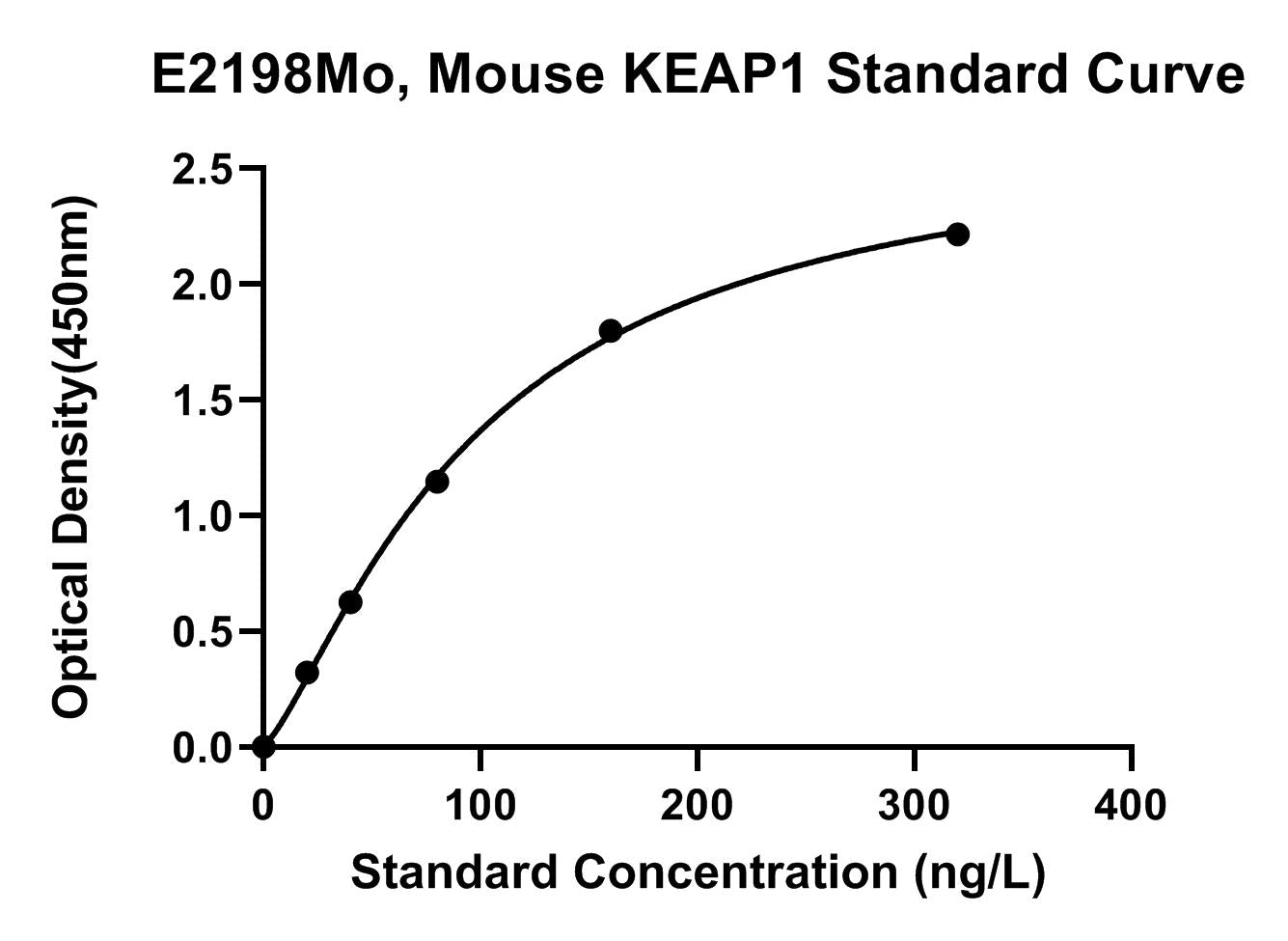
0.97 ng/L
Detection Range
2-600 ng/L
Sample Type
Serum, plasma, cell culture supernates
Incubation(s)
1.5 hour(s)
Research Areas
Epigenetics and Nuclear Signaling
Background
Substrate-specific adapter of a BCR (BTB-CUL3-RBX1) E3 ubiquitin ligase complex that regulates the response to oxidative stress by targeting NFE2L2/NRF2 for ubiquitination (PubMed: 9887101, PubMed: 12682069, PubMed: 15282312, PubMed: 15367669, PubMed: 15581590). KEAP1 acts as a key sensor of oxidative and electrophilic stress: in normal conditions, the BCR(KEAP1) complex mediates ubiquitination and degradation of NFE2L2/NRF2, a transcription factor regulating expression of many cytoprotective genes (PubMed: 9887101, PubMed: 12193649, PubMed: 14764894). In response to oxidative stress, different electrophile metabolites trigger non-enzymatic covalent modifications of highly reactive cysteine residues in KEAP1, leading to inactivate the ubiquitin ligase activity of the BCR(KEAP1) complex, promoting NFE2L2/NRF2 nuclear accumulation and expression of phase II detoxifying enzymes (PubMed: 12193649, PubMed: 20$498.00|$360.00371, PubMed: 22014577, PubMed: 29590092). In response to selective autophagy, KEAP1 is sequestered in inclusion bodies following its interaction with SQSTM1/p62, leading to inactivation of the BCR(KEAP1) complex and activation of NFE2L2/NRF2 (PubMed: 20421418, PubMed: 20173742, PubMed: 24011591). The BCR(KEAP1) complex also mediates ubiquitination of SQSTM1/p62, increasing SQSTM1/p62 sequestering activity and degradation (PubMed: 28380357). The BCR(KEAP1) complex also targets BPTF and PGAM5 for ubiquitination and degradation by the proteasome (By similarity). Source: UniProt Consortium (2025)
Shipping Condition
Shipped on cold gel packs.
Storage Condition and Shelf Life
2-8C
Analyte
Kelch-Like Ech-Associated Protein 1
Regulatory Status
For Research Use Only