1
/
of
1
Rat RAC1 (Ras-related C3 Botulinum Toxin Substrate 1) ELISA Kit
Rat RAC1 (Ras-related C3 Botulinum Toxin Substrate 1) ELISA Kit
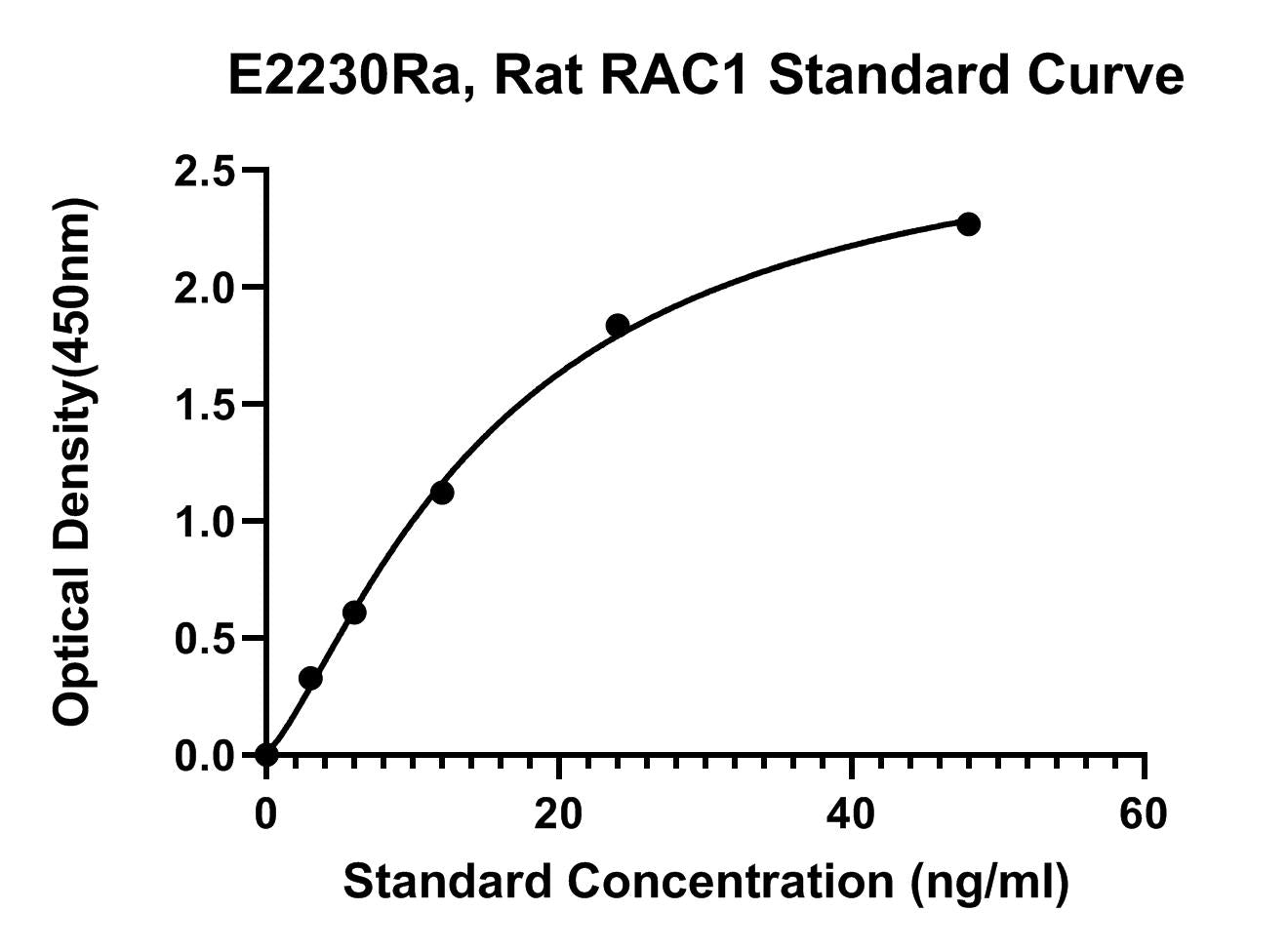
The Rat (RAC1) Ras-related C3 Botulinum Toxin Substrate 1 ELISA Kit measures Ras-related C3 Botulinum Toxin Substrate 1 in Rat samples. The plate has been pre-coated with Rat RAC1 antibody. RAC1 present in the sample is added and binds to antibodies coated on the wells. And then biotinylated Rat RAC1 Antibody is added and binds to RAC1 in the sample. Then Streptavidin-HRP is added and binds to the Biotinylated RAC1 antibody. After incubation unbound Streptavidin-HRP is washed away during a washing step. Substrate solution is then added and color develops in proportion to the amount of Rat RAC1. The reaction is terminated by addition of acidic stop solution and absorbance is measured at 450 nm.
Catalog No:
E2230Ra
Regular price
$595.00 USD
Regular price
$458.00 USD
Sale price
$595.00 USD
Unit price
/
per
2.5 weeks
Couldn't load pickup availability
Product Details
Species Reactivity
Rat
Sensitivity
0.15 ng/mL
Detection Range
0.3-90 ng/mL
Sample Type
Serum, plasma, cell culture supernates
Incubation(s)
1.5 hour(s)
Background
Plasma membrane-associated small GTPase which cycles between active GTP-bound and inactive GDP-bound states. In its active state, binds to a variety of effector proteins to regulate cellular responses such as secretory processes, phagocytosis of apoptotic cells, epithelial cell polarization, neurons adhesion, migration and differentiation, and growth-factor induced formation of membrane ruffles (PubMed:16040606, PubMed:16549782).
Rac1 p21/rho GDI heterodimer is the active component of the cytosolic factor sigma 1, which is involved in stimulation of the NADPH oxidase activity in macrophages. Essential for the SPATA13-mediated regulation of cell migration and adhesion assembly and disassembly. Stimulates PKN2 kinase activity (By similarity).
In concert with RAB7A, plays a role in regulating the formation of RBs (ruffled borders) in osteoclasts (PubMed:16040606).
In glioma cells, promotes cell migration and invasion (PubMed:20696765).
In podocytes, promotes nuclear shuttling of NR3C2; this modulation is required for a proper kidney functioning (PubMed:19029984).
Required for atypical chemokine receptor ACKR2-induced LIMK1-PAK1-dependent phosphorylation of cofilin (CFL1) and for up-regulation of ACKR2 from endosomal compartment to cell membrane, increasing its efficiency in chemokine uptake and degradation (By similarity).
In neurons, is involved in dendritic spine formation and synaptic plasticity (PubMed:25498153).
In hippocampal neurons, involved in spine morphogenesis and synapse formation, through local activation at synapses by guanine nucleotide exchange factors (GEFs), such as ARHGEF6/ARHGEF7/PIX (PubMed:12695502).
In synapses, may mediate the regulation of F-actin cluster formation performed by SHANK3 (PubMed:24089484).
In neurons, plays a crucial role in regulating GABA(A) receptor synaptic stability and hence GABAergic inhibitory synaptic transmission through its role in PAK1 activation and eventually F-actin stabilization (PubMed:25284783). Source: UniProt Consortium (2025)
Shipping Condition
Shipped on cold gel packs.
Storage Condition and Shelf Life
2-8C
Analyte
Ras-related C3 Botulinum Toxin Substrate 1
Regulatory Status
For Research Use Only