1
/
of
1
Rat SMAD4 (Mothers Against Decapentaplegic Homolog 4) ELISA Kit
Rat SMAD4 (Mothers Against Decapentaplegic Homolog 4) ELISA Kit
The Rat (SMAD4) Mothers Against Decapentaplegic Homolog 4 ELISA Kit measures Mothers Against Decapentaplegic Homolog 4 in Rat samples. The plate has been pre-coated with Rat SMAD4 antibody. SMAD4 present in the sample is added and binds to antibodies coated on the wells. And then biotinylated Rat SMAD4 Antibody is added and binds to SMAD4 in the sample. Then Streptavidin-HRP is added and binds to the Biotinylated SMAD4 antibody. After incubation unbound Streptavidin-HRP is washed away during a washing step. Substrate solution is then added and color develops in proportion to the amount of Rat SMAD4. The reaction is terminated by addition of acidic stop solution and absorbance is measured at 450 nm.
Catalog No:
E1260Ra
Regular price
$595.00 USD
Regular price
$458.00 USD
Sale price
$595.00 USD
Unit price
/
per
2.5 weeks
Couldn't load pickup availability
Product Details
Species Reactivity
Rat
Sensitivity
2.23 ng/L
Detection Range
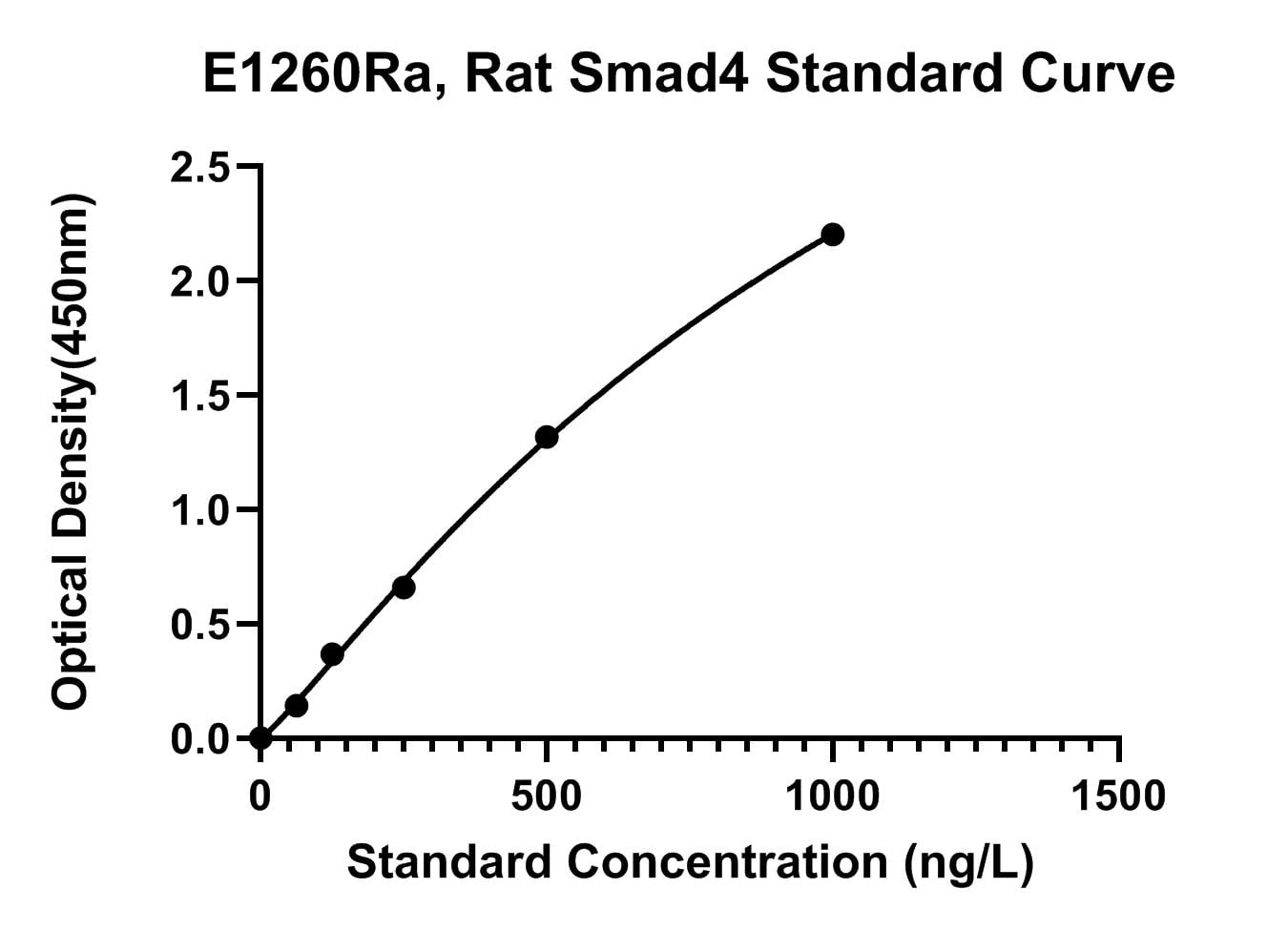
5.16-1800 ng/L
Sample Type
Serum, plasma, cell culture supernates
Incubation(s)
1.5 hour(s)
Background
Common SMAD (co-SMAD) is the coactivator and mediator of signal transduction by TGF-beta (transforming growth factor). Component of the heterotrimeric SMAD2/SMAD3-SMAD4 complex that forms in the nucleus and is required for the TGF-mediated signaling. Promotes binding of the SMAD2/SMAD4/FAST-1 complex to DNA and provides an activation function required for SMAD1 or SMAD2 to stimulate transcription. Component of the multimeric SMAD3/SMAD4/JUN/FOS complex which forms at the AP1 promoter site; required for synergistic transcriptional activity in response to TGF-beta. Acts synergistically with SMAD1 and YY1 in bone morphogenetic protein (BMP)-mediated cardiac-specific gene expression. Binds to SMAD binding elements (SBEs) (5'-GTCT/AGAC-3') within BMP response element (BMPRE) of cardiac activating regions. May act as a tumor suppressor. Positively regulates PDPK1 kinase activity by stimulating its dissociation from the 14-3-3 protein YWHAQ which acts as a negative regulator. In muscle physiology, plays a central role in the balance between atrophy and hypertrophy. When recruited by MSTN, promotes atrophy response via phosphorylated SMAD2/4. MSTN decrease causes SMAD4 release and subsequent recruitment by the BMP pathway to promote hypertrophy via phosphorylated SMAD1/5/8 (By similarity). Source: UniProt Consortium (2025)
Shipping Condition
Shipped on cold gel packs.
Storage Condition and Shelf Life
2-8C
Analyte
Mothers Against Decapentaplegic Homolog 4
Regulatory Status
For Research Use Only